SUN 1 NOV · 1:00PM
3D Sunday at TechInc
TechInc hackerspace at ACTA · hosted by Technologia Incognita
registerfree

What's happening: Week of 26 October 2026
TechInc hackerspace at ACTA · hosted by Technologia Incognita

001 Commandantswoning, Marineterrein · hosted by Appsterdam

TAG · hosted by Tech Makers
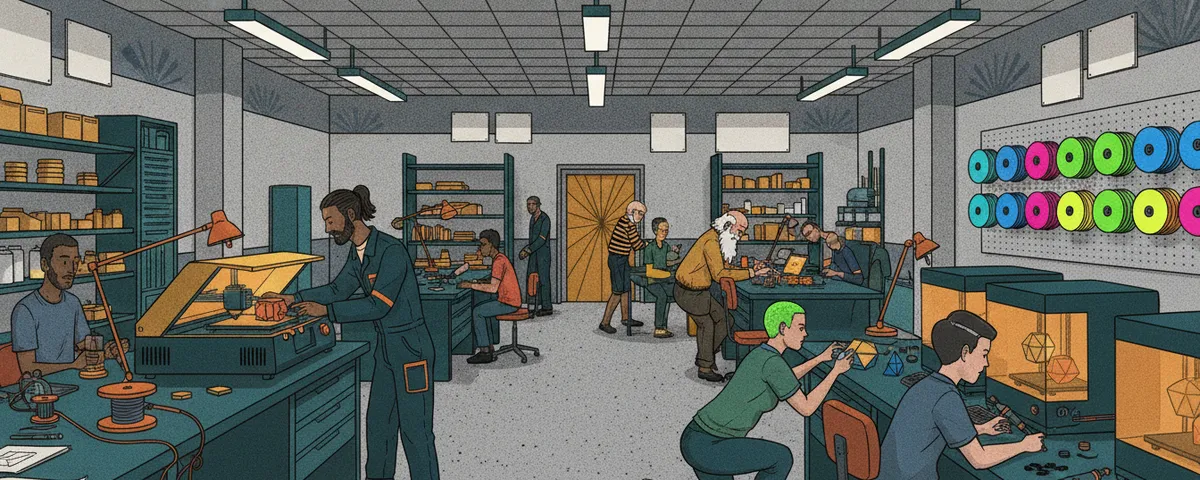
The monthly computer-controlled-making session at Technologia Incognita's hackerspace in the ACTA building: laser cutter, 3D printers and CNC router all running. This edition opens with a basic FreeCAD tutorial, then…
A pop-up co-making day at the 001 Commandantswoning on Marineterrein, hosted through Appsterdam: an open, low-barrier space where people from any discipline work alongside each other. Bring your own project,…
Tech Makers' monthly open evening for the Dutch tech and startup community: drinks, short startup pitches from the floor, and the kind of conversation where people compare what actually went…
SPOTLIGHTFounders · Social
Tech Makers' monthly open evening for the Dutch tech and startup community: drinks, short startup pitches from the floor, and the kind of conversation where people compare what actually went wrong. Founders apply in advance through the organisers' form for a pitch slot. At TAG on Jacob Bontiusplaats, 18:00 to 21:00, free to attend. Tech Makers runs one of the larger founder communities in the Netherlands and also operates a co-founder matching platform, so the room skews early-stage, with the investors who look at that stage. Photos and video are taken for community and promotional use.
Fri 30 Oct · 6:00pm · TAG
Tech Makers' monthly open evening for the Dutch tech and startup community: drinks, short startup pitches from the floor, and the kind of conversation where people compare what actually went wrong. Founders apply in advance through the organisers' form for a pitch slot. At TAG on Jacob Bontiusplaats, 18:00 to 21:00, free to attend. Tech Makers runs one of the larger founder communities in the Netherlands and also operates a co-founder matching platform, so the room skews early-stage, with the investors who look at that stage. Photos and video are taken for community and promotional use. Why go: the pitching is what lifts this above drinks. You leave knowing what three or four new Amsterdam companies are building and who is behind them. Best for early-stage founders, people hunting a co-founder, and angels.

SaaS · Social · Other
Appsterdam's weekly Saturday morning co-working session, this week at The Coffee Room on Ferdinand Bolstraat. Bring a laptop and whatever you are working on; there is no programme, no speaker and no ticket. From 09:30. It has run for years and is open to anyone who writes code.
Sat 31 Oct · 9:30am · The Coffee Room
Appsterdam's weekly Saturday morning co-working session, this week at The Coffee Room on Ferdinand Bolstraat. Bring a laptop and whatever you are working on; there is no programme, no speaker and no ticket. From 09:30. It has run for years and is open to anyone who writes code. Why go: a standing Saturday slot where you can get three focused hours done with company, and ask the person next to you when you get stuck. Best for freelancers and side-project builders who find working alone at home unproductive.
One email. The week's best events, picked by a person, not an algorithm.
SPOTLIGHTSocial · Design
A pop-up co-making day at the 001 Commandantswoning on Marineterrein, hosted through Appsterdam: an open, low-barrier space where people from any discipline work alongside each other. Bring your own project, whatever it is - code, hardware, textiles, writing. 10:00 to 18:00 on Sunday 1 November, free.
Sun 1 Nov · 10:00am · 001 Commandantswoning, Marineterrein
A pop-up co-making day at the 001 Commandantswoning on Marineterrein, hosted through Appsterdam: an open, low-barrier space where people from any discipline work alongside each other. Bring your own project, whatever it is - code, hardware, textiles, writing. 10:00 to 18:00 on Sunday 1 November, free. Why go: a full Sunday of quiet working space on the Marineterrein, with a deliberately mixed room rather than a developers-only one. Best if you want to finish something while surrounded by people doing the same, and would rather not sit through a programme.
SPOTLIGHTDeepTech · Social
The monthly computer-controlled-making session at Technologia Incognita's hackerspace in the ACTA building: laser cutter, 3D printers and CNC router all running. This edition opens with a basic FreeCAD tutorial, then goes into open machine time with members on hand to troubleshoot your model. 13:00 to 20:00 on Sunday 1 November, free, newcomers welcome.
Sun 1 Nov · 1:00pm · TechInc hackerspace at ACTA
The monthly computer-controlled-making session at Technologia Incognita's hackerspace in the ACTA building: laser cutter, 3D printers and CNC router all running. This edition opens with a basic FreeCAD tutorial, then goes into open machine time with members on hand to troubleshoot your model. 13:00 to 20:00 on Sunday 1 November, free, newcomers welcome. Why go: practical maker time on machines most people cannot justify owning, with someone there who has already made your mistake. Best if you have a part you want cut or printed and have never touched the software.
Women in Product NL and Picnic on what AI tooling is actually changing about product management, and which parts of the job it is leaving alone. Held at Picnic's headquarters…
Peter Marshall (Imply) · Lewis Isaac (Coralogix)
The Q4 Amsterdam edition of SREday: four parallel tracks of site-reliability and observability talks, hosted in ING's Cedar building in Amsterdam Zuidoost. 09:30 to 18:00 on 2 November, across a…
The Dutch edition of the global Meet Magento conference: a full day of e-commerce engineering, platform architecture and merchant strategy for the Magento and Adobe Commerce community, closing with an…
with Peter Marshall (Speaker, Imply) · Lewis Isaac (Speaker, Coralogix)
The Q4 Amsterdam edition of SREday: four parallel tracks of site-reliability and observability talks, hosted in ING's Cedar building in Amsterdam Zuidoost. 09:30 to 18:00 on 2 November, across a main room, an upstairs room and two meeting rooms. The programme opens with an ING keynote on SRE inside the bank, then Peter Marshall of Imply on why agentic observability needs a different storage and compute engine, and Lewis Isaac of Coralogix on measuring whether AI coding agents actually make delivery teams more effective. Much of the day is about operating systems that AI agents are now writing and investigating. Paid; registration through the SREday site. Why go: observability events are usually vendor-led, and this one has practitioners from a large bank and several platform companies arguing about the same problem in the same room. Best for SREs, platform engineers and anyone running production inside a regulated business.
The first summit built specifically around what FMCG brands in the Benelux need from digital commerce. One day at Hotel Jakarta on the Java-eiland, 08:00 to 18:00. Senior retail, FMCG and technology people working through omnichannel, retail media, shopper marketing and revenue growth management. More than three quarters of the room is brand- or retailer-side, which is unusual for a commerce event — most are vendor-heavy. Paid conference; the ticket price is not published on the registration page. Why go: the brand-side majority is the reason to be in this room rather than at a retail-media vendor day. Best for commerce, growth and digital leads at consumer brands selling in the Netherlands and Belgium.
with Nadia Edwards-Dashti (Spotlight talk: AI-era resilience research, EWPN) · Sam Emery (Spotlight talk: AI-era resilience research, EWPN)
The European Women Payments Network's annual conference, a full day at AI House on keeping AI in financial services human, inclusive and accountable. The programme runs from a keynote on human-centred design as a strategic requirement, through panels on leadership in the AI era, who the real customer is once autonomous agents start making payment decisions, designing for high-stakes life events, and separating AI-native products from AI-washed ones, to a closing session on data dignity and consent. Spotlight talks cover the EU AI Act and UK resilience research from Nadia Edwards-Dashti and Sam Emery. Lunch included, free to attend. Why go: payments people arguing about agent-initiated transactions and AI Act compliance a year before most firms have to. Best for fintech product, risk and compliance leads.
Women in Product NL and Picnic on what AI tooling is actually changing about product management, and which parts of the job it is leaving alone. Held at Picnic's headquarters on Van Marwijk Kooystraat. Doors and networking from 17:30, a talk by Leah Bekkering at 18:10, then a hands-on workshop run by Women in Product NL at 18:40, followed by drinks and bites. It is the second of three workshops in the group's 2026 mentorship cohort, but the organisers are explicit that the session is open to everyone regardless of experience, profession or gender, and that newcomers to the Netherlands are welcome. Free. Why go: most AI-and-product events are speculation; this one is a working session on discovery, spec-writing and prioritisation with people who do the job. Best for product managers and anyone moving into product who wants practice rather than predictions.
The monthly Amsterdam Perl Mongers gathering, hosted at Mintlab on Sint Olofspoort: short talks and informal discussion for Perl and general systems-programming people. From 18:30, free. Amsterdam PM has run long enough that the room is mostly people who maintain production Perl, a narrow but genuinely scarce group. The listing itself is in Dutch. Why go: one of very few places left in Europe where working Perl developers meet in person, and worth knowing about if you maintain anything written in it. Best for Perl developers, sysadmins and systems programmers.
The day before Meet Magento Netherlands, Mage-OS runs a contribution hackathon at Bold Commerce in Amsterdam: core fixes, extensions and documentation with maintainers on hand. From 10:00, free. Mage-OS is the community-governed Magento distribution, so work done here lands in the codebase rather than in a sandbox. It is a natural add-on for anyone already travelling in for the conference on 5 November. Why go: the most direct route into the Magento and Mage-OS codebase if you work in Dutch e-commerce, and the one day the maintainers are sitting next to you while you do it. Best for Magento developers and agency engineers who want to contribute rather than consume.
with Willem Veelenturf (Software Engineer and co-founder, Flock.community) · Jerre van Veluw (Software Engineer, creator of Wirespec, Flock.community) · Alejandro Serrano Mena (Researcher, JetBrains)
Two talks on contracts, from opposite ends: the integration kind and the compiler kind. Willem Veelenturf and Jerre van Veluw of Flock.community walk through Flock's architecture and Wirespec, their tool that turns an API contract into type-safe code on both sides of an integration, then build contract-based integration tests from scratch live with Kotest. Alejandro Serrano Mena of JetBrains follows on in-place, return and flow contracts in Kotlin, what the compiler does with them, and how they are turning into new language features. Free, at Xebia on Wibautstraat. Doors 17:45 with food and drinks, talks at 18:40 and 19:40, drinks from 20:30. Hosted by the Dutch Kotlin User Group with Flock Community and Sourcelabs. Why go: a JetBrains engineer explaining contracts in person, and a live-coded testing demo you can copy on Monday. Best for JVM and Kotlin developers and anyone maintaining API integrations.
An evening summit in the Zuiderkerk on where AI adoption actually stands in Dutch companies, bringing together around 500 business and technology leaders. Talks and panels first, then open networking. From 18:00, tickets 34.99 euro. Run by Startup Network Europe, which also runs the Amsterdam Startup Meetup and the European CDAO conference, so expect a mixed commercial audience rather than a research one. Why go: a useful read on what mid-market Dutch firms are really doing with AI, which is a different picture from the one you get at engineering meetups. Best for commercial and technology leaders, consultants, and anyone selling into Dutch enterprises.
Appsterdam's long-running weekly social at Cafe Bax on Ten Katestraat: developers, designers and makers from across the Amsterdam app and web scene. From 19:00, free, no agenda and no tickets. Turn up and find a table. Appsterdam has run this every week for years, which is why it works as a default. There is always someone there, and the crowd rotates enough that it is not a closed circle. Why go: the reliable one. If you are new to the city or between jobs, this is the cheapest standing introduction to Amsterdam's software community. Best for developers and designers who want conversation rather than a programme.
The weekly Wednesday social evening at Technologia Incognita, Amsterdam's volunteer-run hackerspace in the ACTA building on Louwesweg. Open house from 19:00, free, no ticket. People bring whatever they are working on: hardware, electronics, firmware, 3D printing, software side projects. Members are around to show you the space and the machines, and newcomers are the point rather than a tolerated extra. Why go: the lowest-friction way into Amsterdam's maker and hardware scene, and the fastest way to find out whether a hackerspace membership would be worth it to you. Best for hardware tinkerers, electronics people, and anyone with a project that needs tools they do not own.
The Dutch edition of the global Meet Magento conference: a full day of e-commerce engineering, platform architecture and merchant strategy for the Magento and Adobe Commerce community, closing with an evening social. At LIEF Amsterdam on Basisweg, from 08:00. Run by Mage-OS Netherlands, the Dutch arm of the community-governed Mage-OS distribution, and paired with a contribution hackathon the day before at Bold Commerce. Tickets are 200 euro. Why go: it is the one day a year the Dutch Magento ecosystem is in a single building, agencies and merchants together, and the talks are pitched at the people who maintain the platform rather than the people evaluating it. Best for e-commerce developers, technical leads at agencies, and merchants running Adobe Commerce.
A two-day business-growth summit at the World Trade Center on Strawinskylaan, aimed at founders and commercial leaders looking for partnerships, investment and distribution. The programme mixes stage content with structured matchmaking. From 09:00, tickets 210 euro. Why go: the matchmaking is the product here rather than the talks, so it earns its place if you arrive with a specific ask - a distribution partner, a first enterprise customer, an investor conversation. Best for founders and commercial leads actively selling or raising; skip it if you want technical content.
DDMA's annual afternoon on experimentation and conversion optimisation at Hotel Casa on Eerste Ringdijkstraat, with practitioners from Dutch digital teams presenting the tests that worked and the ones that did not. From 12:30, tickets 164.79 euro. DDMA is the Dutch data and marketing association, so the room is in-house growth and CRO teams rather than agencies pitching. Why go: the failed tests are the reason to come. Published case studies rarely include them, and this is a room where people present them in front of peers who will question the method. Best for growth, product and CRO people who run experiments for a living.
with Hisko Hulsing (Animator and director, Independent) · Daan Archer (Copyright specialist, Copyright Delta)
An hour on what AI is doing to animation and visual storytelling, and on who owns what comes out. Hisko Hulsing - the Amsterdam animator and director behind Montage of Heck, Undone and Junkyard, and one of the few people using AI inside a traditional animation pipeline - talks about the craft side and about the backlash he has had from the creative community. Daan Archer of Copyright Delta takes the copyright and authorship side. Talks and discussion 16:00 to 17:00 in room L3.36 on the third floor of LAB42, then drinks, snacks and networking. Free, registration through Luma. Run by LAB42, the University of Amsterdam's AI hub, as a co-creation with HAVA-Lab, the Data Science Center and Zeta Alpha. Why go: the AI-and-copyright argument usually happens either among lawyers or among artists, rarely in the same room, and this hour has a working animator and a copyright specialist in it. Best for people building creative tools and anyone whose product touches generated images or video.
with Sako Arts (CTO Netherlands, Wonderful) · Joris Dekker (Leading Deployment, Duna)
A fireside chat on forward deployed engineering: embedding engineers inside customers to make AI work in production, rather than shipping one-size-fits-all SaaS and hoping. Sako Arts, CTO Netherlands at Wonderful, talks with Joris Dekker, who leads deployment at Duna. Wonderful raised a $550 million Series C in September led by Insight Partners, more than doubling its valuation to $5 billion, and operates in more than 35 countries. They cover what marks out a good forward deployed engineer, why embedding with customers beats generic SaaS in an AI-first environment, the tension between white-glove service and scale, managing executives alongside day-to-day stakeholders, and how to structure change management. Doors 17:00, fireside chat and Q&A 17:15, drinks and bites 18:00 to 19:00, at Keizersgracht 127. Free, registration subject to host approval. Why go: forward deployed engineering is the role everyone is hiring for and almost nobody has defined. Best for engineering leaders and founders selling AI into enterprise accounts.
The Dutch Bitcoin podcast Satoshi Radio holds its Amsterdam meetup at Cafe de Roemer on Roemer Visscherstraat: an evening of protocol and market talk with the show's listeners, developers and the wider Dutch crypto community. From 18:00, free. Mostly conducted in Dutch. Why go: one of the few reliably recurring Web3 rooms in the city, and a distinctly different crowd from the AI-heavy rest of the Amsterdam calendar. Best for Bitcoin and protocol developers, and anyone who wants the Dutch crypto conversation without a conference badge.
A recurring evening meetup for people in the Dutch startup ecosystem at Mulligans on the Amstel: founders, early employees and the investor-curious. Low-key, with no pitches from the stage, just introductions over a drink. From 18:30, tickets 12.10 euro. Run by Startup Network Europe, which also runs the Amsterdam AI Summit the night before. Why go: cheap, central and predictable, which makes it a reasonable first stop if you have just arrived in the Amsterdam startup scene and want faces rather than content. Best for new founders and early employees; experienced operators will find the signal thinner than at the smaller community evenings.
with Romy Goedhart (Co-founder, VYNX) · Grace O'Brien (Co-founder, Pink Chip) · Stephanie Robles (Co-founder and CEO, Saint)
Capital C's morning brunch for female founders, entrepreneurs and investors, held at its Bloemenmarkt space on the Singel. The conversation is about starting, funding and growing a company, and the hard parts of each. Speakers: Romy Goedhart, co-founder of VYNX, which recently raised 1.5 million euros; Grace O'Brien, co-founder of Pink Chip, whose work with UN Women won three Gold and two Silver Lions at Cannes Lions; and Stephanie Robles, co-founder and CEO of AI company Saint. 09:00 to 11:30. Seats are limited, register on Luma. Why go: founder-to-founder talk with people who have raised money and shipped, in a small room. Best for early-stage female founders looking for peers and investor introductions.
Appsterdam's Saturday morning co-working session at The Coffee Room on Bilderdijkstraat: bring a laptop and whatever you are stuck on, and work alongside other programmers who can unblock you. Runs 09:30 to 11:30 sharp, so arriving near the start matters if you want help. Maike and Daniel host, and the regulars cover Android, iOS, Flutter, C++, JavaScript, Python, Rust and UX tooling including Figma and Sketch. All levels explicitly welcome; free, no ticket. Why go: the cheapest way in Amsterdam to get a second pair of eyes on your own project rather than listening to someone else's talk. Best for solo developers, learners and anyone whose side project has stalled.
Daniel Steinberg (Do iOS 2026) · Peter Friese (Do iOS 2026) + 2 more
The Netherlands' iOS developer conference, back for its eighth edition at the NEMO Science Museum beside Amsterdam Centraal: a workshop day followed by two days of talks. Workshops from 09:00…
Max Welling (CuspAI) · Steven Latré (imec)
Day one of ChemAI 2026, at AI House Amsterdam in the Prosus building: how AI is changing chemistry and materials science, with the emphasis on execution rather than theory. Speakers…
TEDxAmsterdam's sixteenth main event takes After Growth as its theme: what comes next for technology, business models and cities once endless expansion stops being the goal. A full afternoon and…
with Daniel Steinberg (Workshop host, Do iOS 2026) · Peter Friese (Workshop host, Do iOS 2026) · Tibor Bödecs (Workshop host, Do iOS 2026) + 1 more
The Netherlands' iOS developer conference, back for its eighth edition at the NEMO Science Museum beside Amsterdam Centraal: a workshop day followed by two days of talks. Workshops from 09:00 on 10 November — Daniel Steinberg on Apple's Foundation Models, Peter Friese on production AI with Foundation Models, Gemini and Firebase, and Tibor Bödecs on server-side Swift with Feather, Hummingbird and OpenAPI, with drinks at 17:00. The conference days, 11 and 12 November, open at 08:30 for talks from 09:15; Alex Antonov covers getting an iOS medical app ready for FDA testing. Walking dinner on day one. Paid, through the organisers' own ticket shop. Why go: hands-on workshops with the people who write the books on this, and an Apple-Intelligence-heavy programme in the year that matters. Best for iOS and Swift engineers, and mobile leads planning on-device AI work.
A one-day hackathon on breaking and then hardening the AI agents now sitting inside audit, risk and compliance work. Red teams from Prosus and Skuridat attack the open-source agents of the Shared Audit Agents Framework live and show what needs fixing; the room then builds the defences across the whole repository. Around 100 auditors, developers and security specialists, deliberately mixed so people who know what an agent should never do sit with people who can make sure it doesn't. Brought together by TAG with SAAF, Mollie, Prosus and Skuridat, and hosted by Ben vanLeeuwaarde and Tijs Nieuwboer. 09:00 doors and coffee, red team attacks, then building; 12:30 lunch, demos and wrap-up, 17:00 networking drinks, 17:30 close. At Mollie in Amsterdam. Registration needs host approval and the exact address is shared once you are approved. Why go: live adversarial testing of agents in a regulated workflow is rare, and rarer with the auditors in the room rather than in the review afterwards. Best for security engineers and anyone putting agents near compliance decisions.
with Nikhil Gupta (, ) · Anna Kosek (, RTL Nederland) · Michael Coté (, )
DevOps Amsterdam's first meetup after a break, hosted at ING's Cedar building near Bijlmer Arena station. Three 30-minute talks: Nikhil Gupta on an AIOps design that prepares incident context for an AI agent, Anna Kosek on 23 ways the platform team at RTL Netherlands uses AI agents, and Michael Coté on seven ways to fail at building an internal developer platform. Doors and food from 17:30, talks from 18:30, drinks until 21:00. The organisers are also working towards DevOpsDays Amsterdam 2027 and say more news is coming. Why go: platform teams talking about what went wrong as well as what worked, with food included. Best for SREs, platform engineers and DevOps leads.
Netventis' one-day conference on getting AI from prototype to production, at the Van der Valk Hotel Amsterdam Zuidas. Practitioners from PwC, Cargill, the University of Amsterdam, Uber, Deloitte and DSM-Firmenich speak on agentic AI, enterprise AI platforms and architecture, AI economics and FinOps, and AI-ready data products, with an agentic AI panel, roundtables and networking. 08:30 to 18:00, lunch and drinks included. Early-bird tickets were on sale; the price was not listed. Why go: speakers who run AI inside large companies, with a focus on cost and architecture rather than demos. Expect an enterprise audience and some consultancy content. Best for AI and data leads at larger firms.
with Pratik Patel (AI Data Engineer and Developer Advocate, Hugging Face)
A hands-on afternoon building a customer-feedback pipeline end to end. Bring a laptop. Starting from 2.1 million real Amazon reviews on the Hugging Face Hub, you use DuckDB to pinpoint which products are sliding, wire that SQL to an LLM through Gradio's gr.Workflow so the model reads only the complaints that matter and reports the themes behind them, then deploy the result as a live Hugging Face Space backed by Storage Buckets and callable as an API. Pratik Patel, AI Data Engineer and Developer Advocate at Hugging Face, runs it. Free, 12:00 to 17:00 at the AWS office on Mr. Treublaan. Why go: five hours of building rather than slides, and you leave with a working app and a pattern that transfers straight to your own data. Best for data and analytics engineers and anyone putting an LLM next to a database.
with Ian Zhai (, TiDB) · Mattias Jonsson (, TiDB) · Daniël van Eeden (, TiDB) + 1 more
AMS DB's November meetup is hosted by TiDB (PingCAP) in the Disruption Hall at Epicenter Amsterdam. The theme is distributed, scalable transactional databases. Ian Zhai of TiDB talks about db9, a PostgreSQL-compatible database written in Rust with autonomous AI agents. Mattias Jonsson and Daniël van Eeden of TiDB cover running transactions on an object store. Rohit Nayak, a core Vitess engineer now at PlanetScale, covers sharding PostgreSQL with Neki. Doors at 18:00, talks from 18:20, food and networking until 21:00. Free, with about 40 spots left when we checked. Why go: three database builders in one evening, including a core Vitess engineer on sharding Postgres. Best for backend engineers and data infrastructure leads comparing ways to scale.
with Max Welling (Chief Technology Officer, CuspAI) · Steven Latré (Vice President of AI, imec)
Day one of ChemAI 2026, at AI House Amsterdam in the Prosus building: how AI is changing chemistry and materials science, with the emphasis on execution rather than theory. Speakers include Max Welling, CTO of CuspAI, and Steven Latre, VP of AI at imec, alongside deeptech founders and investors on scaling, industrial adoption and autonomous laboratories. Run with Techleap, Hello Tomorrow, TTT-AI, StartupAmsterdam and Amsterdam AI. From 12:00, free. Why go: chemistry people and AI people are usually in separate rooms, and this is the one where materials researchers, deeptech founders and the investors funding them argue about the same bottleneck. Best for deeptech founders, ML researchers working on scientific problems, and investors in materials and chemistry.
TEDxAmsterdam's sixteenth main event takes After Growth as its theme: what comes next for technology, business models and cities once endless expansion stops being the goal. A full afternoon and evening of stage talks at Pakhuis de Zwijger on Piet Heinkade, from 14:00. Tickets are 48.15 euro. Why go: it is the closest thing Amsterdam has to a cross-sector stage, so the growth question gets put by people outside tech as well as in it, which is usually where the uncomfortable version of the argument comes from. Best for founders and product people thinking hard about what they are optimising for, and anyone who wants a day off the AI conference circuit.
with Saskia Heyster (Data analyst, DDMA Digital Analytics)
A DDMA Digital Analytics meetup hosted at Digital Power on the Wenckebachweg, on what conversational analytics can and cannot do. Saskia Heyster - a data analyst who has worked across retail, e-commerce, hospitality and FMCG - presents experiments comparing AI-generated analysis with the work human analysts do, showing where the tools already hold up, where they fall over, and what data democratisation looks like once you try it in practice rather than in a vendor deck. 15:30 to 19:00, free for DDMA members and non-members alike. Why go: a named analyst showing her own test results instead of a platform roadmap, which is rare in this corner of the market. Best for analysts, data leads and anyone being asked whether an LLM can replace their dashboard.
TechMeetups has been running its Amsterdam job fair since 2017, and the format hasn't changed because it works: an exhibition-style evening with no talks and no speeches, just one-on-one conversations between job seekers and hiring companies. It's open to people in IT, software, data, digital, sales, operations, marketing and finance. Exhibitors confirmed so far include UbiOps (AI model serving) and Salute (data centre services), with the University of Amsterdam and DevITJobs as partners. The last Amsterdam edition drew 698 registrations, with data and analytics people the biggest group, followed by software and IT. The venue will be announced closer to the date. Recruiters are expected to buy an exhibitor package or an HR pass rather than come in on a candidate ticket. Why go: if you're job hunting in Amsterdam tech, three hours here puts you in front of more hiring managers than a month of applications, and there's no keynote to sit through first.
An evening of founder talks on how AI is changing products and work, run by COnext TECH events at Berghaus Amsterdam (Koningin Wilhelminaplein 2A). Three speakers: Chingiskhan Kazakhstan, co-founder and CEO of SELANA, on starting a tech company as a non-technical founder; Sven Brookhuis, co-founder of Oasy, on saving digital publishers in the agentic era; and Ilan Lewin on building a $100,000 sensor from $100 of hardware. Welcome at 18:00, talks from 18:30, open discussion on building in Europe from 19:30, drinks until 21:00. Ticket price isn't listed on the page. Why go: the sensor talk is the draw for hardware-curious builders, and the non-technical-founder session helps if you're pitching without a CTO. Expect a networking-heavy crowd, not deep technical content.
Day two of ChemAI 2026, the science-heavy conference day at Hotel Casa Amsterdam (Eerste Ringdijkstraat 4), run by the Amsterdam Chemistry Network. 09:00 to 18:00, doors open 08:30. The programme is presentations, panels, an innovation market and a poster session on machine learning for chemistry and materials. Listed speakers: Heike Riel, Tonio Buonassisi, Aron Walsh, Thibault Géoui and Alexander Hammer. Day one (12 November, AI House) is a separate registration. The ticket page shows no price we could confirm; startups can email info@acnetwork.nl for a promo code. No refunds. Why go: this is the research-heavy day after the founder-facing day one, with posters and an innovation market where you can corner the people building the models. Best for researchers and deeptech founders working on materials; less useful for general startup networking.
An afternoon at AI House built around the grand finale of the EIT AI Entrepreneurs Lab 2026, where a selected cohort pitches after five days across Paris, Brussels and Amsterdam. Around the pitches: perspectives from the AI and robotics ecosystem, interactive sessions and networking with investors, corporates and university research groups, run as part of European AI Innovation Month. 14:00 to 17:00, free. Places are limited and registration is an expression of interest - the organisers confirm attendance afterwards to keep the mix of founders and investors balanced. Why go: the pitching founders were filtered by EIT rather than self-selected, so the quality floor is higher than an open pitch night. Best for investors looking at early AI and robotics, and founders who want to be in that room.
Appsterdam's Saturday-morning Coffee Coding at The Coffee Room — open co-working for developers over coffee.
The Benelux Google Cloud user group meets at Xebia for an evening of practitioner talks — platform engineering, data, and the current state of Google's AI tooling, presented by the…
The Netherlands edition of Hardwear.io, the hardware security conference, at the Amsterdam Marriott on Stadhouderskade: three days of practical training from 16 to 18 November, then two conference days on…
The Amsterdam edition of Security BSides, the community-run information security conference, at KIT Amsterdam on Mauritskade. The organisers are aiming at over 400 practitioners this year. Talks skew technical and…
The Netherlands edition of Hardwear.io, the hardware security conference, at the Amsterdam Marriott on Stadhouderskade: three days of practical training from 16 to 18 November, then two conference days on 19 and 20 November. Talks go deep on firmware, silicon, side channels and embedded attack surfaces, with competitions alongside. Paid; the organisers have not published a face price for this edition. Why go: hardware security has no substitute for being in the room with the people doing it, and this is the one European gathering that reliably assembles that crowd. Best for embedded and firmware engineers, hardware security researchers, and product teams shipping physical devices.
A session at AI House Amsterdam on where AI and competition law meet: algorithmic pricing, foundation-model concentration and what regulators are signalling to companies building on top of the big model providers. No organiser name is published on the listing.
The follow-up to the SAAF security challenge on 10 November, and the session where the open parts get closed. The agents, the audit criteria and the shared library are built; this day goes over every agent, fixes what the red teams found, and locks each fix in with a test. Three strands run through the day: repairing agents, checking each one against its audit criteria pass or fail, and tightening access, logging and sign-off across the framework. SAAF brings auditors and builders from more than 65 organisations together to build AI agents for audit work in the open. Hosted by TAG at The Stack, with Ben vanLeeuwaarde, Sofia Frumkina, Tijs Nieuwboer and Mathijs Schouten. BDO is title sponsor. Doors 09:00, hardening until 17:00, drinks to 18:00. Free, 50 places, 36 taken. Why go: agents for regulated audit work get hardened with the auditors who sign them off in the room, not in the review afterwards. Best for security and platform engineers putting agents near compliance decisions.
with Simon Schrottner (Engineer, Flagsmith) · Zeljko Kozina (Engineer, Chronomill)
Two talks at Flagsmith's Plantage Kerklaan office, hosted by the Amsterdam Java User Group. Simon Schrottner of Flagsmith covers feature flags once the easy part is over: several languages to support, targeted evaluation, vendor lock-in and retiring dead flags, and how OpenFeature's vendor-agnostic SDKs handle them. Zeljko Kozina of Chronomill follows with wrapping an ageing Java service -- dozens of REST endpoints, a SOAP relic, session auth, nobody left who understands it -- as MCP tools so AI agents can call it without a rewrite. Free, 18:00 to 21:00. The listing is on waitlist. The group takes speaker proposals by email for later editions. Why go: the MCP-over-legacy-Java talk is the problem most enterprise teams are about to hit, and it is rare to hear it addressed without a rewrite pitch attached. Best for Java and platform engineers and architects carrying old services.
A working session at Startup Village on how early-stage tech companies build a concept and a story people repeat: positioning, naming and the narrative that has to survive a pitch deck, a landing page and a hiring conversation.
A VR workshop using the orbital view of Earth as a starting point for conversations about systems thinking and planetary limits, run at the Social Impact Factory in Amsterdam Noord.
The Benelux Google Cloud user group meets at Xebia for an evening of practitioner talks — platform engineering, data, and the current state of Google's AI tooling, presented by the people running it in production rather than by Google marketing. Hosted by Google Cloud User Group Benelux at Xebia Netherlands, from 17:30. Talks and open discussion, free, sign-up through the group's Meetup page. Why go: a vendor-community room that has stayed technical — the talks are about what broke and what it cost, not product launches. Best for cloud and data engineers, platform teams and architects working on GCP in the Dutch market.
The November edition of AI Builders Club's monthly technical meetup for people shipping with generative AI: devtools, APIs, RAG and agent frameworks, models, and what is actually holding up in production. Three short slots make up the programme and the speakers are announced closer to the date. At StartDock Coworking on Prins Hendrikkade. Walk-in 17:30, pizza at 18:00, talks from 18:30, drinks and networking from 19:15, ends at 21:00. Tickets are name-your-own-price from a 20 euro suggestion, with a 10 euro student and bootstrapper tier that needs approval. Basic LLM knowledge is assumed. Why go: the room is builders rather than buyers, which keeps the questions technical and the demos honest. Best for AI and ML engineers, developers and technical founders already building with LLMs.
with Fellyph Cintra (, )
WP Meetup Amsterdam hosts Fellyph Cintra on WebMCP, a proposal that lets a website tell AI agents which actions it offers. He shows examples in WordPress Playground, where to start experimenting, what precautions to take and how to contribute to the proposal. Fellyph has worked with WordPress since 2008 and has spoken at more than 20 WordCamps, including WordCamp Asia and WordCamp Europe 2026. Wednesday 19:00 to 21:00 at Stayokay Hostel Amsterdam Oost, Timorplein 21. RSVP on Meetup. Why go: agents that browse and act on sites will reach every plugin and theme developer, and this is a practical first look from someone close to the work. Best for WordPress developers and agency builders.
The weekly Wednesday social evening at Technologia Incognita's hackerspace at ACTA — open house for hardware, electronics and software projects.
with Helen Rijkes (Partner (keynote and moderator), Rewire) · Daniel Gebler (Founder and CTO, Picnic) · Daan Klein Douwel (Head of Data & AI, KLM Royal Dutch Airlines) + 3 more
A one-day, 40-person gathering of European data and analytics chiefs at Rewire on the Mauritskade, on codified knowledge and scaling agentic AI in the enterprise. Helen Rijkes of Rewire opens and moderates a panel with Daniel Gebler (founder and CTO, Picnic) and Daan Klein Douwel (head of data and AI, KLM). Three roundtable blocks follow - governance with autonomy, measuring agent impact beyond efficiency, and grounding agents with knowledge graphs - led by data directors from adidas, Mondelez, dsm-firmenich, Elsevier, Decathlon and Unilever, with curated 1:1 matchmaking in between. Registration 08:00, close 15:30. Paid, with early-bird tiers well below the standard price. Attendance is limited to data leaders at companies above roughly 500 staff. Why go: forty people who each own a real data estate, in roundtables rather than on a stage. Not useful if you are not one of them.
The Amsterdam edition of Security BSides, the community-run information security conference, at KIT Amsterdam on Mauritskade. The organisers are aiming at over 400 practitioners this year. Talks skew technical and unpolished in the good way: BSides programmes are built by the local infosec community rather than a vendor committee. Paid. The organisers' site reports first-wave tickets sold out with a final wave still to come, so check availability before planning around it. Why go: the Dutch security community's own conference, where talks come from the people who found the thing rather than the people selling the fix. Best for security engineers, pentesters, researchers and blue-team practitioners.
with Harry Roberts (, ) · Tim Kadlec (, ) · Pat Meenan (, ) + 4 more
performance.now() is a single-track web performance conference at the Oosterkerk on 19 and 20 November. Talks cover JavaScript and CSS performance, framework performance, performance budgets and culture, perceived performance, monitoring and compression. The 2026 line-up includes Harry Roberts, Tim Kadlec, Pat Meenan, Tammy Everts, Jeremy Keith, Scott Jehl and Stéphanie Walter, with Robin Marx and Jason Pamental as MCs. Day 1 starts at 09:30. Tickets start at 700 euros plus VAT, and a live stream is offered. Why go: many of the best-known names in web performance on one stage, and single-track means everyone sees everything. Best for front-end and platform engineers with a performance budget to defend.
The Dutch Research Software Engineering community meets at the Netherlands eScience Center on Science Park: talks and working sessions on building software that research actually depends on — testing, reproducibility, packaging and the career question of being an engineer inside academia. Relevant to anyone working at the research-engineering boundary, and a good route into the Amsterdam scientific computing network.
A free evening run by AI Natives for teams trying to get real work out of the AI tools they already pay for, rather than evaluating new ones. The pitch is deliberately narrow: measurable value from Copilot, ChatGPT or Claude, starting the week after. Two short talks from people who use AI in their day jobs, covering what they built, what changed and what went wrong, followed by a walkthrough of things you can apply immediately on work like your own. Hosts Evgeny Kalinin and Gleb Starchikov close with networking over drinks so you can push back on the speakers directly. 18:00 to 20:00. Free, seats are limited, registration is approval-based and the exact Amsterdam address is sent to approved guests. Why go: a practical counterweight to conference-stage AI talk, aimed at people who have to show a result at work. Best for team leads, ops people and engineers rolling AI out internally.