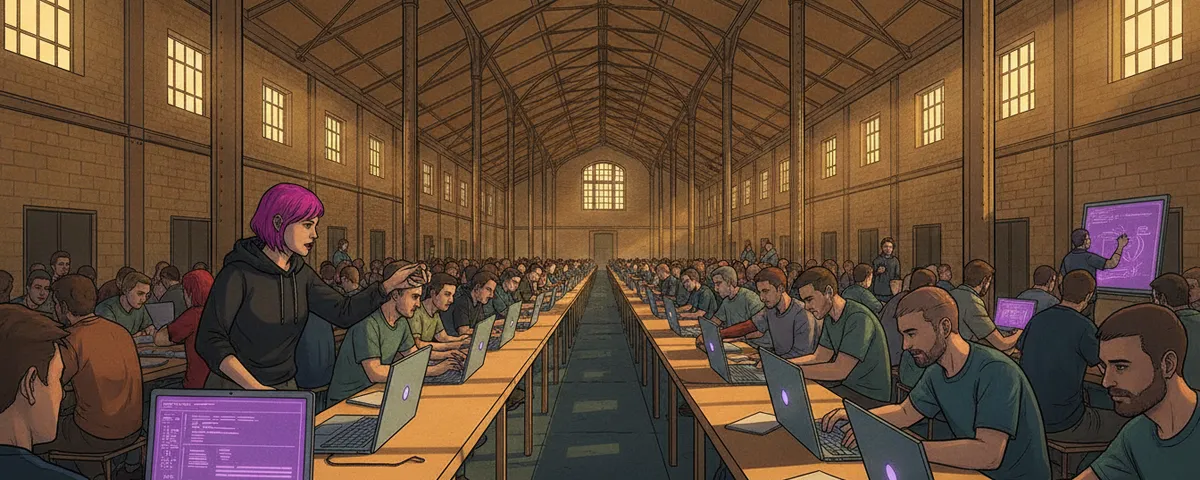
Urbe Hub's AI Forum asks which AI models you can realistically run on your own hardware. Live benchmarking on an NVIDIA DGX Spark, then an open floor discussion on the cost, privacy and latency trade-offs between local inference and cloud APIs.

rome
What's happening: Week of 7 September 2026
Wednesday 9 September— 1 event
Friday 11 September— 3 events
ETHRome returns for its fourth edition and, for the first time, moves into its own home at Urbe Hub in Testaccio. Forty hand-picked builders, three days, one weekend of building — each participant arriving with concrete work already in motion rather than an idea on a napkin. Three tracks structure the weekend: AI for web3, finance for web3, and privacy for web3. Meals are covered throughout, and the room is shared with the urbe.eth community. ETHRome has always positioned itself as by builders, for builders, and the deliberate cap on numbers is the point: this is a working hackathon rather than a conference with a hack track bolted on. Comfortably the most substantial technical event in Rome this window.
Rome Tech Social's weekly Friday mixer for people working in software, AI, data and IT, now running from Testardo in Trastevere. The format is deliberately unstructured, with no talks and no pitch slots, and draws a steady mix of engineers, data practitioners, IT consultants and international newcomers to the city. On this date it is one of the only regular tech gatherings running in Rome, with most community groups and university calendars not resuming until the second half of September. Tickets are sold online in advance rather than on the door.
A free masterclass from IE University's Italy and Southern Europe office, built around a technology-industry CEO who has scaled international teams past 300 people and taken ventures into Asia and other global markets. The session covers the mindset, strategy and operating habits behind sustained international expansion, and each attendee is offered a 20-minute one-to-one coaching slot focused on entering new markets, launching new business lines, or working through a specific growth constraint. The individual coaching component makes this unusually concrete for a free event, and places are limited by the format.
week of 14 September 2026
Monday 14 September— 2 events
ESORICS is Europe's flagship academic conference on computer security research, and its 31st edition runs for five days at Sapienza. Expect peer-reviewed work on cryptography, privacy, systems security and applied AI security, plus a dense workshop programme that draws security researchers and industry practitioners from across Europe. A serious, technical week rather than a networking event — worth the trip for anyone working in security engineering or research.
Opening ceremony of the eighth Digital Security Festival, held at the Senate of the Republic. Power, security and responsibility in the age of AI, with institutional and industry speakers setting the agenda for the national programme that follows.
Wednesday 16 September— 1 event
Startup Night returns to Zest Hub beside Termini — the building that houses LUISS EnLabs and the densest concentration of early-stage capital in Rome. Founders pitch to a room of investors and operators, with structured feedback and open networking afterwards. A free ticket tier exists alongside the paid one; if you are raising in Lazio this is the room to be in.
Thursday 17 September— 2 events
The first Italian edition of this healthtech summit runs across two days near Termini, covering how AI, data platforms and connected devices are reshaping clinical and administrative practice. The audience skews towards hospital IT, healthtech founders, regulators and the consultancies working with them. Free to attend, which is unusual for a summit of this scope.
GLOW runs a free evening meet-up at Zest Hub for women building careers and companies in Rome's tech and innovation ecosystem. The format mixes short talks with facilitated peer conversation, so it is useful whether you are a founder, an operator or moving into a leadership role. Held in the Termini innovation cluster, a short walk from the station.
Friday 18 September— 1 event
Evolve Business Agility's Rome community meets for a practical session on what actually works for managers leading technical teams — decision cadence, delegation and the agile practices that survive contact with a real organisation. Small, discussion-led and free. The venue is announced to registered attendees rather than published on the listing.
Saturday 19 September— 1 event
The third Rome AI Festival takes over Cinema Adriano for an evening on where generative AI is actually landing in Italian creative, media and product work. A cinema is an unusual venue for an AI event and it suits the programme, which leans towards screenings, demos and on-stage conversation rather than slide decks. Free, central and the strongest single AI evening in Rome before Rome Future Week opens.
week of 21 September 2026
Monday 21 September— 7 events
A seven-hour, five-session day at Talent Garden Ostiense opening Rome Future Week, on where the boundary between human judgement and machine output should sit in everyday work. Sessions run back to back so you can drop into the ones that matter to you. Free, and a good way to see the Ostiense campus if you have not been.
Oria Futures runs a hands-on futures-thinking workshop at Urbe Hub: you leave with a structured set of scenarios for how AI changes your own business model, not a general overview. Places are limited and the €24 ticket keeps the room to people who will actually do the work. Urbe Hub sits inside Città dell'Altra Economia in Testaccio.
What do we actually know about AI's impact on human work? Fondazione ENIA convenes ENIA, INAIL, institutional bodies and field practitioners at INAIL's auditorium for a hype-versus-evidence session on workplace safety, skills and the shape of AI-era jobs.
The Italian Space Agency and ESA run a two-day programme on Earth observation — what the current satellite constellations actually measure, how the data reaches downstream users, and where the commercial opportunities sit. Rome is the centre of Italy's space economy and this is one of the few open-door events the agencies run. Free, with registration through the Rome Future Week programme.
Cloned voices, spoofed bank numbers, delivery-SMS phishing. Volontari per la Protezione Digitale run a practical self-defence session at CSV Lazio on how AI-assisted fraud actually works and the habits that stop it.
INFORAV argues that understanding quantum computing and AI is a civic right, not a specialist privilege. A session at UNINT that explains both fields in plain language and asks what happens to democratic decision-making when only a few people follow the technology.
LUMSA hosts a grounded session on quantum computing — what is genuinely close to commercial use, what the cryptographic migration means for organisations now, and how Italian research groups are positioned. Useful if you need a defensible view on quantum for a board or a roadmap rather than the usual hype cycle. Free, in central Prati.
Tuesday 22 September— 13 events
Simon Coe leads a breakfast session at Talent Garden Ostiense on how startup strategy actually changes when foundation models commoditise part of your product. Held in English, which makes it one of the more accessible Rome Future Week sessions for the city's international founder community. Free, but the room is small.
Origin is Rome Future Week's startup track and this is its opening afternoon at Zest Hub: five hours on building in the US versus Europe, public money versus venture capital, how the Rome and Turin ecosystems compare, and open innovation with corporates. Run with Needs Startup Association and Zest Hub, so the room is genuinely operator-heavy. Free.
Assodigit convenes a forum on vibe coding — building software by directing models rather than writing every line — and, more usefully, on what breaks when teams try it on production systems. Practitioner-led rather than vendor-led. Free, part of the Rome Future Week programme.
Recube walks through how cloud platforms and ML services are actually assembled into working products, with reference architectures rather than abstractions. Industrie Fluviali in Ostiense is one of the better tech venues in Rome and the morning slot pairs naturally with Recube's agentic-AWS session the same afternoon. Free.
A working session on building agentic applications on AWS — orchestration, tool use, guardrails and the cost profile once agents run unattended. Aimed at engineers and architects who have moved past prototypes. Free, at Industrie Fluviali in Ostiense.
Three hours of aperitivo and open networking at Zest Hub, closing the first day of the Origin startup track. Tot, TaxCoach, Eleven, Talent Garden, STEP, GLOW and Needs are all partnering, which means most of the people running Rome's startup infrastructure are in one room. Free, and the single best networking slot of Rome Future Week.
EIT Manufacturing South convenes a half-day on Europe's industrial competitiveness: how AI, automation and virtual factory tooling are changing production, and what skills and investment the twin digital-green transition needs.
MiFinanzio opens its Rome office for a morning on public funding: which 2026 calls and subsidised-finance instruments exist for early-stage companies, how to prepare properly, and how to turn an open call into a fundable project.
The fourth AcceleraImpresa cohort pitches at Rome's Casa delle Tecnologie Emergenti, the municipal deeptech hub at Tiburtina. Demo days at CTE tend to surface companies working on 5G, IoT and urban tech that never reach the generalist accelerator circuit. Free, and a good vantage point on what the city itself is funding.
Three founders at different stages — starting, scaling, and one who walked away — plus a VC ready to challenge the rules of the game. An unusually honest panel about the myths behind the pitch-deck version of startup life.
A hands-on workshop for professionals, content creators and teams on AI-generated content: Substack's detection tooling, LinkedIn's flagging, the EU's coming label, Claude's machine-readable watermark — and why none of them reliably answers who made a thing.
Sony Computer Science Laboratories runs its Rome branch as a genuine research lab, and this session opens up how novelty and innovation can be studied scientifically — the group's own line of work on the adjacent possible and creative processes. One of the few chances to hear a corporate research lab in Rome talk about its research rather than its products. Free.
Intelligentiae's CEO Paolino Madotto argues the case against leaderboard-driven model selection and sets out what evaluation should look like when you are shipping an LLM feature to real users. Held at Binario F, the Meta-backed community space inside the Termini innovation block. Free.
Wednesday 23 September— 21 events
Startup Grind Rome connects West Coast and Asian investors with Rome-based startups over an afternoon of talks and structured matching, with Lydia Flocchini, Jose Padilla of LegalMente AI and Prof. Okke Schlüter confirmed. The chapter also previews the global Redwood City event in April 2027. Free, in English, and the most internationally connected room in Rome that week.
Mindstone's Rome chapter runs the format that made the London one the best AI meetup in that city: practitioners presenting what they actually built, followed by unhurried conversation. This September edition, billed as the ButterflAI Effect, lands at Talent Garden Ostiense during Rome Future Week and is cross-listed on both Meetup and Eventbrite. Free, in English, and the best recurring AI room in Rome.
The evening repeat of Simon Coe's startup-strategy session at Talent Garden Ostiense, run over aperitivo for people who cannot make the breakfast slot. Same material, more networking. Free and in English.
The opening day of ELIS's Impronta accelerator programme at Villa Fassini — cohort introductions, the programme's corporate partners and what the selection process looks for. Useful reconnaissance if you are considering applying to a Rome-based accelerator next cycle. Free.
A two-day global summit on AI in healthcare, convened by the AI CoLab MedStar-Georgetown Collaborative Center. Focus on behavioural health, clinical ethics and human-centred applications of machine learning in care settings.
Talent Garden and Oria Futures run a breakfast built to avoid the usual card-swapping: facilitated small-group conversation with a set question rather than open mingling. If you find conventional networking events exhausting but still need the contacts, this is the better-designed alternative. Free.
with Giampaolo Murabito (AI Specialist, Data-Driven.Ai)
A free two-hour hands-on lab with Data-Driven.Ai specialist Giampaolo Murabito: build and publish a modern multilingual company site with a working contact form, using agentic development end to end.
The second Origin morning covers the university as a startup engine, EdTech, the startup-studio model, go-to-market and the future of work — five hours of panels at Zest Hub with founders and investors rather than institutional speakers. Free. If you can only make one Origin block, the 23rd has the denser programme.
with Paola Lanzi (Head of Automated & Multimodal Transports, Deep Blue)
Paola Lanzi of Deep Blue on why enterprise AI adoption is not only a compliance exercise: how to establish that a system is genuinely reliable, safe and effective in the context where it will actually run.
with Davide Pala (Senior Presales Engineer, Stormshield)
A beginner-level lab with Stormshield senior presales engineer Davide Pala. Not about becoming a pentester — about understanding how an attack is actually assembled, what reconnaissance it needs, and which defences break it.
Kaizen Institute Italy hosts this one inside Yokohama TWS's Tivoli plant: in an era of accelerated digitalisation and AI, the argument is that the binding constraint on organisations is cultural rather than technological. Strategy session plus shop-floor visit.
We spend ninety per cent of our time indoors and know almost nothing about the air there. INFORAV at the Lazio Regional Council on indoor air sensing, the data it produces and how it gets certified — the smart city starting from the room you are in.
Lazio Innova, the region's public-private investor, puts on an Innovation Day for the games and creative-industries sector — funding instruments, studio case studies and the regional programmes actually open to applications. Worth attending if you are building anything at the intersection of games, media and technology in Lazio. Free.
ELIS hosts Vertis SGR and Open Advisory at Villa Fassini for a session on where institutional money is actually going in Lazio, and what a regional fund looks for before it writes a cheque. A rare chance to hear a fund manager set out the thesis in public. Free.
IBM opens its Rome Cyber Academy — normally a closed training facility near Piazza di Spagna — for a Rome Future Week session on how a security operation actually runs on an ordinary bad day. Getting inside the Cyber Academy is itself the reason to go. Free, with limited places.
Centro Studi Americani, with UNINT and Geopolitica.info, on what real EU digital sovereignty would require — chips, cloud, standards and industrial policy — in a period of intensifying systemic competition.
An interactive Deep Blue workshop on what happens when a model has to make real decisions: how fairness, transparency and safety translate into everyday workflows, and who carries the responsibility when they don't.
The closing Origin block: technical mistakes founders repeat, building a growth engine, AI beyond the hype, fundraising, and going from zero to scale-up. Five hours at Zest Hub with practitioners running the sessions. Free.
UNINT's open lecture on Social Engineering Intelligence — an interdisciplinary frame combining sociology, cyber-psychology, cybersecurity and intelligence to map human vulnerabilities in complex systems and design defences for them.
Fondazione Kainòn works the definition properly: what separates an agent from a chatbot, an automation or a workflow, and what conditions a system has to meet before agentic is an honest label for it.
Flowlee on why the static backend/frontend split no longer holds: with AI agents, adaptive interfaces and A2UI models, the product interprets, suggests, decides and acts — and the architecture has to change to match.
Thursday 24 September— 18 events
A space-economy morning at Industrie Fluviali: Rome's institutional role and governance in the sector, then the path from research to market — building a space company, and the capital, incubation and growth routes open to space startups.
An early-morning working breakfast at Talent Garden Ostiense on getting AI adoption past the pilot stage inside an established organisation. Small-format and free, part of Talent Garden's Rome Future Week programme.
with Xavier Del Giudice (AI Engineer, Data-Driven.Ai)
Data-Driven.Ai engineer Xavier Del Giudice takes the room from chatbots to systems that act — searching, consulting sources, executing operations, choosing their own route to a goal. You build one from scratch in the browser using free models.
with Simone Pozzi (CEO, Deep Blue)
The afternoon half of Rome Future Week's space day: Space for Women, a Serco-led Space for Earth block, human performance in extreme environments, and an interview with Deep Blue CEO Simone Pozzi.
Opening morning of The E-commerce Club: e-commerce as infrastructure rather than a website — platform architecture, data, migration paths and the growth models that sit on top of them.
Newsrooms already use AI to research, draft, rework and repackage — but usually outside the CMS and without shared procedure. Assodigit on tools, responsibilities and concrete cases for making it a process.
Confcommercio Roma with TIM Enterprise and BIP on applied AI in retail and fashion — customer understanding, process innovation and the competitive gap it is already opening between firms.
Sign language is one of the harder problems in AI: it combines body movement, handshape, orientation, signing space and facial expression, so models have to read multimodal input both in isolation and continuously. SignsMeta on where the research currently stands.
Intelligentiae convenes ROMA.AI at Roma Tre's engineering campus — a survey of what the city's AI companies, labs and research groups are actually shipping, rather than a conference about AI in the abstract. Good for mapping who is doing what in Rome before you go looking for a partner or a hire. Free.
SaaS made software cheap to adopt and easy to run — and left many companies with a drift of subscriptions, licences and integrations that don't talk to each other and quietly shape their processes. Assodigit on what to rent, what to build and what to own.
Radical HR's working session on getting past tool-by-tool adoption to an actual agentic org chart: how you govern a hybrid workforce of people and autonomous AI agents, worked through concrete cases.
SocialHRCamp brings its unconference format to Rome Business School: HR and talent people working through how AI, automation and social tools are changing hiring and internal comms. Relevant well beyond HR if you are scaling a team. Free.
A session at Dotcampus on what changes for developers when the writing of code stops being the bottleneck — review, specification and communication become the job. Practical rather than philosophical, aimed at working engineers. Free.
Maiker Hub caps this one at 25 people and builds something in the room rather than talking about it. €15, at CORE Backstage Hub in Monte Mario. Maiker also runs Rome's monthly AI aperitivo, so the crowd is a mix of builders and curious operators.
The Indian Embassy on Digital Public Infrastructure: open-source, scalable digital tools provided as public goods, and how that model let a country of 1.4 billion leapfrog across sectors. Held in English.
42 Roma, the free peer-to-peer programming school, opens its campus: how the method works, interactive activities on site, and staff on hand for people considering it with no coding background at all.
Most AI projects produce nothing measurable — not because the technology fails but because people chase the impressive demo instead of the boring work that eats the day. A practical evening for owners and managers, explicitly not for developers.
Turning an idea into a product used to need a structured team, real budget and months of development. ZERO Remote Farm walks through how they now use AI day to day, and how a real internal need became AskMentor.
Friday 25 September— 7 events
AgID, Italy's digital agency, runs a five-hour session on digital identity, the IT wallet, public-sector cyber and where AI is being deployed across the administration. Rome is where Italian govtech is decided, and this is the agency itself setting out the roadmap. Free — relevant to any supplier or founder selling into the public sector.
Banca d'Italia takes the digital euro out of the technical committees and into a public session at The Social Hub — what the design decisions mean for banks, PSPs and fintechs building on top of it. Central-bank speakers in an open room are rare; if you work in payments this is the fintech event of the season in Rome. Free.
Tor Vergata's biomedical engineering group demonstrates working brain-computer interfaces driving games and music, run by Prof. Luigi Bianchi. Hands-on lab access rather than a lecture — genuinely unusual, and free.
A full-day Rome Future Week hub on cities, professions and real estate: how technology, AI, sustainability and new skills are changing the way urban space gets designed, lived in, managed and valued. Panels and talks at Palazzo Orsini Taverna.
Nobody innovates alone — companies want institutional counterparts, institutions want expertise, research wants a route to the real world. INFORAV, a non-profit institute founded in 1973, on the work of being the place where those groups actually meet.
CyberEthics Lab and Tor Vergata's DITeS on AI, data and the legal and social responsibilities that follow: digital technology does not only change services and markets, it changes how people are seen, profiled and included.
From a photograph of a garment to a finished fashion campaign, generated live with AI. An immersive demonstration of how the creative and production process in fashion is being rebuilt, at Galleria Marte in Monti.
Saturday 26 September— 5 events
Rome's Joomla user group on the part of open source that is not code — governance, contributor pipelines and keeping a volunteer community alive over two decades. Useful for anyone maintaining an open-source project or a developer community, whatever the stack. Free, in a bookshop near Porta Pia.
Via Lattea brings the autonomous weapons debate out of diplomatic rooms and into a Testaccio bookstore inside the former slaughterhouse — meaningful human control, and where the treaty negotiations currently stand.
One brief, two hours, seventy designers, a real challenge. Newphoria brings its live creative competition to Talent Garden Ostiense for designers, graphic designers and creatives who want to work under the clock.
Technology was meant to simplify work; instead managers, teams and HR spend their days in notifications, disconnected platforms and interruption. Flowlee starts from data on cognitive overload and attention fragmentation and asks whether we are working better or just faster.
Radio Soccorso Roma on drones plus AI in emergency management — continuous territorial monitoring, risk prevention and the most critical search-and-rescue operations, where the technology has moved from support to operating method.
Sunday 27 September— 3 events
A masterclass on avatars and synthetic voices, framed around surviving the crisis of trust they create. Part of the Premio PLAY Festival, hosted at Talent Garden.
Fab Lab & Co.'s Rome Future Week programme on matter's two contemporary transformations: the biological one through digital biofabrication, material recycling and regeneration, and the digital one through fabrication that turns code into real objects.
From Roger Fenton to Midjourney, photography has always lied. Casa della Fotografia di Roma on image ethics, copyright, photographers' professional identity and the future of photojournalism.
week of 28 September 2026
Monday 28 September— 2 events
Roma Capitale convenes the Smart City Lab consultation inside Palazzo Senatorio on the Campidoglio — the city's own forum for urban technology, data and connected infrastructure. The venue alone is worth the registration, and it is the clearest read available on the municipality's technology priorities. Free.
Four days of intensive hands-on security training in Garbatella, run by the Cyber Saiyan non-profit. The 2025 edition drew 72 students from 21 countries across five courses; every participant also gets a free ticket to RomHack Camp immediately afterwards. Paid, with sales closing 25 September — classes below minimum numbers can be cancelled, so book early.
Tuesday 29 September— 1 event
AlmavivA opens its Rome headquarters for an evening of tech talks and drinks. Almaviva is one of the largest Italian-owned IT groups and runs much of the country's transport and public-sector infrastructure, so the engineering problems on show are at genuine scale. Free, and a rare look inside a corporate that rarely hosts publicly.