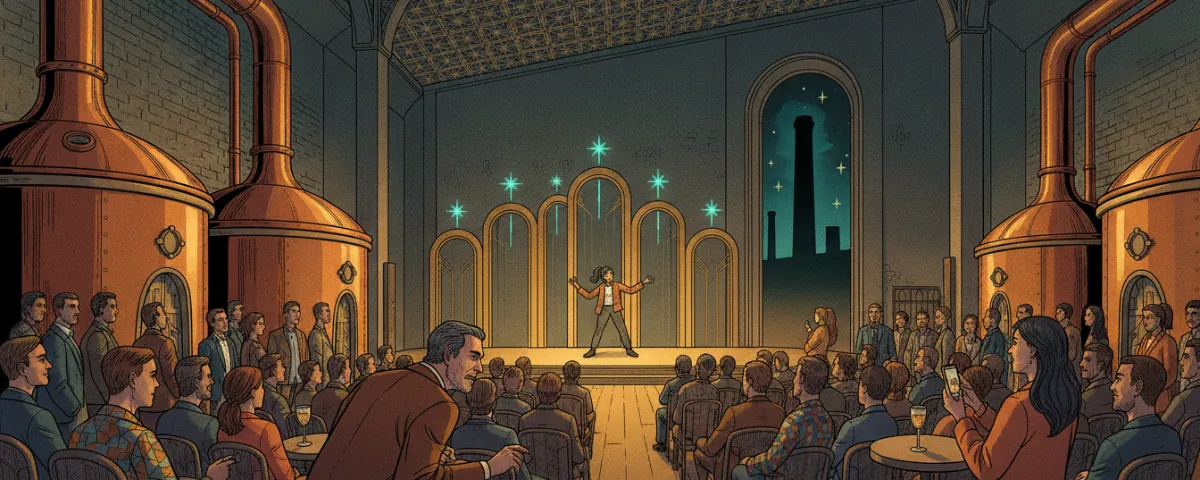
The finale of Esade's eWorks accelerator, at the Antiga Fàbrica Estrella Damm: the top startups from this year's cohort pitch to investors, with a startup fair alongside. There are separate…

Tech events in barcelona
What's happening: Week of 19 October 2026
EINA, Barcelona's university centre for design and art, hosts a session on what design education and design practice can contribute when generative tools make production cheap and judgement scarce. Less…
JFrog's European developer conference, three days in Barcelona on the software supply chain: binary management, DevSecOps, MLOps and AI-assisted delivery pipelines. Day one is hands-on labs, certification training and a…
Monday 19 October— 3 events
A four-way discussion on what digital technology is actually doing to the climate - the energy it burns and the emissions it enables - and what people in Barcelona's tech sector can do about it. The panel sets aside the two usual positions, that AI dooms the climate or fixes it. The four speakers come from different angles: a mobile app product manager who also organises in her community, a climate communications specialist who retrained as a software developer, a multimedia art educator, and a chemist working in circular economy. Hosted by Barcelona Climate Week at the Thoughtworks office in Sant Marti. Free, registration required. Why go: a climate-and-tech room aimed at practitioners rather than policy people, and the mixed panel gets you past the engineering view. Best for engineers, product people and anyone in Barcelona tech looking for something concrete to do.
with Hooman Rezvani (Speaker, eDO Ignite) · Jorge Márquez Moreno (Speaker, eDO Ignite)
eDreams ODIGEO opens its Bailèn office for the first edition of eDO Ignite, a new talks series for people working in tech, UX, data, product and design. Two talks on where AI actually leaves designers. Hooman Rezvani looks at what happens when AI tools hand a team twenty viable options and no way to converge, and what to fix at the skill, process and business-metric level. Jorge Márquez Moreno asks what user experience becomes when screens stop being central to how we use technology, and what ownership means when the platform can disappear. Doors 18:30, check-in closes 19:15. You need to complete the eDO registration form and bring photo ID for building access. Networking after the talks. Why go: design and product teams have no shortage of AI output and no good way to choose between it. Two practitioners on exactly that, not a tool demo. Best for designers, UX researchers and product leads.
The seventy-fifth edition of the BCN Globals waterfront run and social, starting from La Carioca. Five kilometres, drinks afterwards, entrepreneur-heavy crowd. Free.
Tuesday 20 October— 6 events
JFrog's European developer conference, three days in Barcelona on the software supply chain: binary management, DevSecOps, MLOps and AI-assisted delivery pipelines. Day one is hands-on labs, certification training and a leadership summit, followed by a welcome reception. Days two and three carry the main technical programme and the expo floor. At the InterContinental Barcelona, 345 euros. Why go: supply-chain security and artifact management are where a lot of delivery pain actually lives, and nothing else of this size in Europe is built entirely around that problem. It is a vendor conference, so weigh the JFrog framing accordingly. Best for platform and DevOps engineers, and release or security leads with a real artifact estate to run.
EINA, Barcelona's university centre for design and art, hosts a session on what design education and design practice can contribute when generative tools make production cheap and judgement scarce. Less about tooling than about how you decide what is good, which is a question the design disciplines have been formalising for a century. At EINA Bosc, free. The session is conducted in Catalan. Why go: most generative-AI events in the city are about what the tools can do; this one is about how to tell whether the output is any good, which is the harder and much less discussed half. Best for designers, design educators and product people who have to make taste calls on AI output. Check the Catalan before you book.
A free afternoon conference from Catalonia's AI research and innovation network, bringing together the research groups, companies and public bodies working on applied AI in the region. Free general admission, real venue, broad programme.
with Asi Burak (Keynote speaker, author of Power Play, Games for Change (former Chairman and President)) · Eva Dominguez (Speaker, Immersive Creatures)
Demos, a keynote and a challenge launch at the intersection of immersive technology and social impact, at Norrsken House on the Barceloneta waterfront. Doors at 18:00 with live demos of immersive projects and impact games. At 19:00 Asi Burak, former chairman and president of Games for Change and author of Power Play, gives the keynote on turning play into real-world change. At 19:30 Eva Dominguez of Immersive Creatures talks about the studio behind Ivanani, and the Genesis Creator Challenge launches. Open networking over the Mediterranean from 20:00. Co-hosted by Games for Change and the Immersive Creators Meetup, with support from the Generalitat de Catalunya. Free, registration required. Why go: Barcelona's XR and games-for-impact community rarely gets a speaker of Burak's standing, and the demo hour means you see work rather than slides. Best for game developers, XR creators and impact founders.
The Barcelona chapter of People Planet Pint, the informal monthly gathering for anyone working on sustainability inside a tech or business role. No talks, no pitches — just people who work on this finding each other over a drink.
codebar runs free, one-to-one coding workshops for people underrepresented in tech, pairing students with volunteer coaches for the evening. This edition is hosted by ERNI at its Plaça de Catalunya offices. The format is deliberately plain: bring a laptop and whatever you are trying to learn, get matched with a coach, and work through it. Beginners are the point — there is no prerequisite and no curriculum to keep up with. Experienced developers are equally welcome as coaches, and codebar is usually short of them. Places have to be booked through codebar.io/barcelona rather than Meetup, and seats are limited. Why go: Barcelona has plenty of talks and few places to actually sit down and write code with someone more experienced beside you. This is one of them, it is free, and it is aimed at the people who find the rest of the scene hardest to break into.
Wednesday 21 October— 6 events
A free session at Hub Social Barcelona run by training and consultancy firm GESEM on workplace integration and inclusion programmes. Adjacent to the tech audience rather than squarely in it — listed on the venue and organiser pages. Conducted in Spanish.
A networking lunch at El Tros de la Rambla for women investing in startups — angels, syndicate members and fund people — to connect and widen their circle. Small-format and recurring; attendees cover their own lunch.
The finale of Esade's eWorks accelerator, at the Antiga Fàbrica Estrella Damm: the top startups from this year's cohort pitch to investors, with a startup fair alongside. There are separate ticket types for general attendees, ecosystem partners and investors, all free. Why go: a demo day is the cheapest way to see a whole cohort at once, and Esade's pipeline feeds a good share of Barcelona's early-stage deal flow. The separate investor track means the people in the room came to meet each other rather than to watch. Best for early-stage investors, and for founders who want to see the bar this year's cohort is clearing before they raise.
with Magdalena Ruyú (Business Analytics Consultant, InnoIT Consulting) · Johnny Fekete (Software Engineer, Reddit)
Barcelona's agentic-coding community meets at InnoIT Consulting for a Castanyada-themed evening on working with AI coding agents in real codebases. Magdalena Ruyú, business analytics consultant at InnoIT, opens with the mismatch AI has created: code now lands in days while strategic decisions still take weeks, and what that does to the relationship between technical and business teams. Johnny Fekete, software engineer at Reddit, follows on Claude Code in a large, mature codebase — a shared AI context layer committed to the repo, reusable skills for repetitive work, and turning the agent's recurring mistakes into rules the team reviews like any other code. A beginner-corner lightning talk opens at 18:30. Talks in English, networking from 20:05. Seats are booked on Luma, not Meetup — an RSVP on Meetup does not hold a place. Community-run and not affiliated with Anthropic. Why go: Fekete's talk is the one most teams actually need, agents inside an existing codebase with many engineers rather than a greenfield demo. Best for engineers and tech leads.
IED Barcelona runs a strategic design clinic — a working session rather than a lecture — on the methods design brings to problems that are ambiguous rather than merely difficult. Participants bring their own complex challenge and work on it alongside facilitators drawn from IED's alumni and the wider Strategic Design Management community. The format is guided analysis: look at the problem from several perspectives, challenge the assumptions underneath it, and name the openings. The school is explicit that the aim is not definitive answers but a better conversation, framed around how strategic design connects vision, innovation, business, technology and human experience. Held in English. Free, and showing as sold out at the time of writing, so it is worth checking for returns. No individual facilitators are named on the listing. Why go: a clinic where you bring your own problem is worth more than a panel about someone else's. Best for designers, innovation leads and strategists.
A free monthly gathering for space professionals and enthusiasts in Barcelona — engineers, researchers and people working in the European space supply chain, plus anyone who just finds the field interesting. Relaxed format, no presentations.
Thursday 22 October— 6 events
AppGala brings app founders, product leaders, user-acquisition and growth specialists, developers and games professionals together for a day of case studies and practical mobile growth material at the COAC on Plaça Nova. Barcelona's mobile sector is one of the deepest in Europe and this is the conference that treats app growth as a craft rather than a channel-buying exercise.
Rojo Integrations hosts an afternoon at Pier 07 on using SAP Integration Suite as the backbone for agentic AI processes across DevOps and enterprise workflows. Enterprise integration is not glamorous, but it is where most agentic AI projects actually succeed or stall, and the session runs long enough to get past the slideware.
with Anastasia Videneeva (People Growth Partner, Manychat) · Edu Capell (Engineering Practice Lead, Ocado)
The Barcelona chapter of LeadDev, the engineering-leadership community, meets at Manychat's office in the Eixample for two talks on AI and the management side of engineering. Anastasia Videneeva, people growth partner at Manychat, makes the case for AI as a thinking partner for engineering leaders: something that helps structure context, spot patterns and challenge assumptions, while judgement and relationships stay human. Edu Capell, engineering practice lead at Ocado, follows with Ocado Technology's route from AI pilot to scale, covering how they assess tools, what enablement actually involves and how they measure impact. His argument is that picking the tool is the easy part. Arrival and refreshments from 18:00, talks from 18:35, food and drinks until 21:00. Places are limited and RSVPs close at 23:59 on 21 October. Why go: two people running AI adoption inside real engineering organisations rather than selling it. Best for team leads, engineering managers and heads of engineering.
with Les Echem (Speaker, Building Nando: the agent that ran a crew, Claude Community) · Jeremie Benhamou (Speaker, From idea to brand: the operations behind it, Claude Community)
Two builder talks on putting Claude to work, then drinks, hosted at Factorial's Poblenou office by the Claude Community ambassadors in Barcelona. Doors 18:00, welcome 18:15, talks and Q&A from 18:30, networking with drinks and snacks from 19:15, close at 20:30. Les Echem covers Building Nando, the agent that ran the Claude Community House crew in September: it answered WhatsApp messages and spoke to visitors through a lobby iPad voice agent, and the talk covers how it was built and what broke. Jeremie Benhamou follows on running a brand's operations through Claude day to day. Hosts are Matt Roberts, Jeremie Benhamou, Ben Tarenne and Fernanda Grace Lins. Registration needs host approval and places are limited; there is a waitlist. Why go: both talks come from people who shipped the thing rather than demoed it. Best for engineers, founders, operators and designers already building with agents.
A hands-on evening at Xplore Studio in Poblenou for people who want to build with AI rather than talk about it — practical tooling, working sessions and show-and-tell. Xplore runs a consistent programme of maker-oriented evenings and the format rewards turning up with something half-finished.
with Maria Costa (Creative Technologist, Domestic Data Streamers)
Elisava hosts Domestic Data Streamers for a three-hour hands-on prototyping workshop, part of Barcelona Design Week and run out of the school's Master in Applied AI for Arts and Design. You bring a personal archive or a small dataset — family photos, souvenirs, tattoos, typefaces, tiles, or something off informationisbeautiful.net — and leave with a working interactive interface for exploring it. Maria Costa, creative technologist at Domestic Data Streamers, moderates. The emphasis is on finding the story in the archive and making the interaction carry it, and on being straight about where AI helps, meaning code and speed, and where your own voice and narrative judgement still decide. Bring a laptop and a Google account. Free with prior registration; general admission was showing as sold out. The listing says English while the description is in Catalan, so expect either. Why go: three hands-on hours with one of the few studios here treating data as a material rather than a chart. Best for designers and creative technologists.
week of 26 October 2026
TechMeetups runs its autumn Barcelona tech job fair at Hotel ILUNION, putting hiring companies and candidates in one room for an evening. Free for candidates. Developer, design, product, data and…
A one-day traveltech summit at the Antiga Fàbrica Estrella Damm covering distribution, AI in booking and service, and the platform economics of the travel sector. Tickets 185 euros. Barcelona holds…
Mozilla's flagship festival moves to Barcelona for three days at Fabra i Coats, under the theme Wilding: what happens when rigid digital systems loosen enough for communities and technologies to…
Tuesday 27 October— 3 events
A one-day vendor exhibition and technical seminar on test and measurement instrumentation for electronics and industrial engineering teams.
Vaadin's annual conference on the future of full-stack Java lands in Barcelona at the Hotel Catalonia Plaça Espanya. A full day of framework, architecture and AI-assisted development sessions for Java teams — a genuine international developer conference rather than a local meetup, and the only one of its kind in the window.
with Victor Martín (Principal DevOps Consultant, ERNI) · Enric Font (DevOps Engineer, Adevinta)
The DevOpsDays Barcelona community meets before its conference for two talks, hosted by ERNI on the third floor at Plaça de Catalunya. Victor Martín, principal DevOps consultant at ERNI, takes on spec-driven development — the pros, the cons, the pitfalls and what he has learned building with AI while keeping a human on top. Enric Font, DevOps engineer at Adevinta, follows with "I already told you I was trying to get this done before". Welcome at 18:30, talks from 18:45, networking and snacks from 20:15. Free, and close to full at the time of writing. The host requires ID for office access, so fill in the NIF / NIE / passport field when you register or you will not get in. Why go: two engineers from ERNI and Adevinta on what spec-driven and AI-assisted delivery actually does to a pipeline. Best for platform, SRE and DevOps engineers.
Wednesday 28 October— 5 events
Mozilla's flagship festival moves to Barcelona for three days at Fabra i Coats, under the theme Wilding: what happens when rigid digital systems loosen enough for communities and technologies to evolve together. Sessions cover community-owned networks, open protocols, trustworthy AI and tools built on consent rather than capture, run as participatory workshops rather than keynote theatre. Paid ticket, bought through the Mozilla Foundation checkout. Why go: MozFest is the main European gathering of the people building the non-commercial internet, and this is the year it lands in Barcelona. The workshop format means you contribute rather than watch. Best for anyone working on open protocols, digital rights, public-interest technology or trustworthy AI.
A commercial B2B summit on digital transformation, artificial intelligence and customer experience held near Barcelona-Sants. Ticket prices are in the enterprise-conference range and the programme is sponsor-led, so it is listed on the venue and organiser pages rather than the city feed. Relevant mainly to enterprise buyers with a training budget.
TechMeetups runs its autumn Barcelona tech job fair at Hotel ILUNION, putting hiring companies and candidates in one room for an evening. Free for candidates. Developer, design, product, data and go-to-market roles are all typically represented, and the format favours short direct conversations with hiring managers over an online application queue. Why go: if you are looking, an evening here is worth more than a week of applications, because you reach the person who decides. If you are hiring, it is the cheapest top-of-funnel in the city this autumn. Best for candidates actively on the market, and for in-house recruiters and hiring managers with roles open now.
womanTech Barcelona's monthly free meetup at La Fuga for women working in technology — a mix of informal conversation and career-focused connection. A consistent community fixture; the September edition is already listed and this is the October return.
A casual networking evening for angel investors across sectors to compare deal flow and trends over beers. Venue to be announced at the time of listing; investor-only framing.
Thursday 29 October— 4 events
A one-day traveltech summit at the Antiga Fàbrica Estrella Damm covering distribution, AI in booking and service, and the platform economics of the travel sector. Tickets 185 euros. Barcelona holds one of Europe's denser clusters of travel-technology companies, and this is the sector's main autumn gathering in the city. Why go: the attendee list is as much the draw as the stage, so the day pays for itself if you work on the product or commercial side of travel technology. Skip it if you are only adjacent to the sector, because the programme assumes you know how distribution works. Best for product, revenue and partnerships people in travel.
Cambridge Spark Spain and the Grand Hyatt host a roundtable for HR, people, talent, L&D and digital transformation leaders at companies with a Barcelona presence. The format deliberately prioritises conversation over presentation: a short framing, small-group discussion against set questions, a shared read-out, and a closing panel on moving from insight to action. Worth attending if you own the reskilling problem rather than just reading about it.
Bcombinator hosts a practical session on taking a Spanish or European company into the United States — entity structure, first hires, pricing, and the go-to-market differences that catch European founders out. €5 ticket, held at Bcombinator on Carrer de Badajoz in Poblenou. Concrete and well-scoped for founders actually planning a move rather than considering one in the abstract.
with Clara Fernández Pachiani (Lead Product Manager, MANGO) · Tomás Caraccia (Investor and product and engineering leader, Independent)
ProductTank Barcelona's October edition is hosted at MANGO's offices in Poblenou, with two talks and around 120 product people in the room. Clara Fernández Pachiani, lead product manager at MANGO, tackles the question every PM gets asked too early: how much will this sell? Her subject is what to do when you are building products that will not generate revenue immediately, with examples from her own work. Tomás Caraccia, an investor and former software and platform product and engineering leader, follows on how AI speeds up the kind of learning that actually changes company outcomes. Doors 18:30. Free, and currently on a waitlist. Note the entrance is not on Almogàvers — access is via Carrer de Pamplona, the perpendicular street. Why go: a lead PM at a company with real scale on how to justify products that do not pay back this quarter. Best for product managers, founders and anyone who has to defend a roadmap.
Friday 30 October— 2 events
The Barcelona edition of Security BSides — a community-run, community-priced security conference with live hacking, practical tracks and none of the vendor theatre of the commercial circuit. BSides events are where working security people actually go, and Barcelona's edition has grown steadily. Worth booking early.
Ninety minutes, one marketing topic, ideas you can use the same day — Growth BCN's deliberately compressed alternative to the half-day event with endless presentations. Aimed at marketing leaders at technology companies.
week of 2 November 2026
PyConES is the Spanish Python community's annual conference, and the 2026 edition runs over three days at the Universitat de Barcelona. Friday 6 November is a half day, 14:30 to…
Biocat's deep-tech summit runs inside the Smart City Expo week at Fira Gran Via, pairing science-based founders with the investors and corporates that fund and buy from them. Expect programming…
The world's leading urban-innovation congress takes over two halls at Fira Gran Via with 1,100+ exhibitors and a conference programme across main and open stages. Four congresses are co-located on…
Monday 2 November— 2 events
The twelfth edition of CARNET's urban mobility symposium at UPC, covering connected vehicles, mobility data platforms and what cities are actually deploying. CARNET is the automotive-mobility research hub backed by UPC, SEAT and Volkswagen Group Research.
MobiNexus brings together academics, industry and policymakers from five partner countries to work on the mobility transition — vehicle technology, urban systems and the research-to-market gap. Held at the UPC Camins campus and free to attend.
Tuesday 3 November— 9 events
The blue-economy congress co-located with Smart City Expo brings ocean technology, port innovation, marine renewables and maritime data to Fira Gran Via, with an Innovation Hub for startups and research groups working on the sector. Three days of conference programming aimed at operators, public bodies and investors in ocean industries.
Biocat's deep-tech summit runs inside the Smart City Expo week at Fira Gran Via, pairing science-based founders with the investors and corporates that fund and buy from them. Expect programming on health tech and biotech, advanced materials, quantum and semiconductors, plus structured investor meetings for spin-outs coming out of Catalan research centres.
The world's leading urban-innovation congress takes over two halls at Fira Gran Via with 1,100+ exhibitors and a conference programme across main and open stages. Four congresses are co-located on the same floor — Tomorrow.Mobility, Tomorrow.Blue Economy, Barcelona Cybersecurity Congress and HOWS Barcelona — alongside startup pitches, investor talks and the World Smart City Awards. Visitor passes from €200; full congress and investor passes cost more.
Fira de Barcelona and EIT Urban Mobility run the urban-mobility congress on the Smart City Expo floor: electrification, micromobility, autonomous and connected vehicles, logistics and the data platforms cities use to manage all of it. Three days of conference sessions plus an exhibition shared with the wider Smart City programme.
BLOC4BCN's Jornades Beta asks how to redesign a business around social impact and make AI an ally in doing it. A full morning programme at Barcelona's social-innovation hub, in a week otherwise dominated by Smart City Expo — and the only impact-tech programming the city has scheduled for early November.
Fira de Barcelona and the Agència de Ciberseguretat de Catalunya run three days of security programming in Hall 2, co-located with Smart City Expo World Congress. The agenda covers zero trust, cloud and edge, IoT and 5G, quantum security, supply-chain risk, incident response, governance and the ethics of security AI. Speakers include Marcos Gómez, Pekka Jokinen, Tim Brown, Sounil Yu, Arvin Basal and Chris Hosking.
The November edition of SIA's recurring morning coffee for founders, investors and mentors. Venue not yet confirmed at the time of listing.
Cloud Native Barcelona and the Green Software chapter jointly host the city's Sustainability Month event at Lidl's international tech hub: measuring and cutting the energy cost of Kubernetes workloads, with talks from practitioners running it in production.
The Smart City Expo edition of 22@Network Barcelona's afterwork, which puts the 22@ innovation district's companies in the same room as the international delegations in town for the congress week — including representatives of innovation districts and city governments from around the world. Informal networking format at the Hotel Arts. This is the strongest genuinely in-city event of congress week, most of which happens outside the Barcelona municipal boundary. Conducted in Spanish.
Wednesday 4 November— 4 events
Five minutes, two people, one spark: womanTech Barcelona runs structured one-to-one rotations with fifteen-plus women in tech so attendees leave with named contacts rather than a vague sense of having mingled. Free, gentle format, and genuinely effective for finding a co-founder, mentor or collaborator.
with Sophie Koonin (Staff Engineer, Operations, Monzo) · Wei Ann Heng (Senior Backend Engineer, Subscriptions, Monzo)
Monzo's Barcelona engineers host an evening for women in tech and allies at Aticco Diagrame in the 22@ district, with two short talks from inside the bank. Sophie Koonin, staff engineer on Operations, covers technical migrations at scale: how Monzo goes about upgrading libraries across a very large system, and what that has taught them about running the next migration better. Wei Ann Heng, senior backend engineer on Subscriptions, explains how the team designed Monzo's payday and bill-payment experience to make managing money less work for customers. Roughly 15 minutes each with 10 minutes of questions, then drinks, pizza and networking. Free. Bring ID to get into the building. Why go: migration war stories from a bank running them in production are rarer and more useful than another architecture talk. Best for backend engineers, platform teams and anyone in fintech.
The November edition of a monthly, deliberately casual gathering of product strategists, designers, growth specialists and AI practitioners. There are no talks: people talk over a drink about what they are working on, what is and is not shipping, and how AI is landing in their teams.
The November edition of BUZOKU's bi-monthly meetup in Sant Gervasi for people building in Web3, AI and digital systems. No panels, no presentations, no agenda — deliberately conversational.
Thursday 5 November— 3 events
with Angelina Gentili (HR Director, Semrush) · Johana Mora (Data Analyst, Conversia Consulting Group)
TechFems takes over the sixth floor at Semrush for a session on what AI is doing to hiring, from both sides of the table. Angelina Gentili, HR director at Semrush, talks about evaluating AI tools in recruitment and how to keep a hiring process fair and inclusive while using them. Johana Mora, data analyst at Conversia Consulting Group, gives the candidate's view after moving into data science herself. The question they are both working on is how to get the benefit of AI without making recruitment less human. Doors and welcome at 18:30, talk at 19:00, networking with refreshments from 20:00. In English, open to everyone, free, with registration through Eventbrite. Bring photo ID. Why go: most AI-and-hiring panels are vendors selling screening tools. This is an HR director and a recent career-changer, which is a far more honest pairing. Best for anyone hiring engineers, and anyone job-hunting.
Le Wagon's Barcelona campus hosts an evening of two talks on data products and data security, run in partnership with Women Techmakers Barcelona. The pairing is the interesting part: one half on how data products actually get built, the other on how teams keep sensitive information safe once those products exist. Both talks come from people doing this work day to day rather than from a platform vendor. The format is deliberately relaxed, with time set aside for questions and conversation afterwards. Tickets are €10. The speakers had not been announced when this was written — check the Meetup page before you book if the line-up matters to you. Why go: data security usually gets discussed separately from product work, which is exactly why it arrives late and expensive. An evening that puts both in the same room is worth two hours. Best for data engineers, analysts and anyone shipping a data product.
Sysarmy's first-Thursday gathering for sysadmins, developers, DBAs, InfoSec and networking people at PIBÄ Bar. November edition.
Friday 6 November— 2 events
The twelfth edition of WomanLiderTIC, the Catalan conference on women's leadership in ICT, run by Dones en Xarxa at the Movistar Centre. A full morning of keynotes and panels on careers, digital skills and closing the gap in technology roles.
PyConES is the Spanish Python community's annual conference, and the 2026 edition runs over three days at the Universitat de Barcelona. Friday 6 November is a half day, 14:30 to 18:30 across five teaching rooms. Saturday is the long day, 07:30 to 18:30, with the Paraninfo and Aula Magna as main stages alongside sponsor-named rooms and a dedicated AI track. Sunday closes at 16:30. Talks are given in both Spanish and English, marked per session in the schedule. Tickets are €75 individual, €110 company and €30 for students with proof of enrolment; student validation can take a couple of days, so do not leave it to the last week. Why go: the largest Python gathering in Spain, in Barcelona this year, with a programme built by the community rather than a conference business. Best for Python developers, data and ML engineers, and anyone hiring them.
week of 9 November 2026
Naomi Bagdonas (Stanford Graduate School of Business) · Felipe Gomez (Independent)
Gartner's European CIO conference brings more than 6,500 IT executives to the CCIB for four days under the theme Ignite Intelligence — combining human judgement with AI to create value…
Monday 9 November— 1 event
with Naomi Bagdonas (Lecturer, Stanford Graduate School of Business) · Felipe Gomez (Keynote pianist, Independent)
Gartner's European CIO conference brings more than 6,500 IT executives to the CCIB for four days under the theme Ignite Intelligence — combining human judgement with AI to create value and agility. The Signature Series covers the top strategic technology trends and predictions for 2027 and the CIO's path through AI sovereignty; guest keynotes come from Stanford lecturer Naomi Bagdonas and keynote pianist Felipe Gomez, alongside the IT Xpo solution showcase.