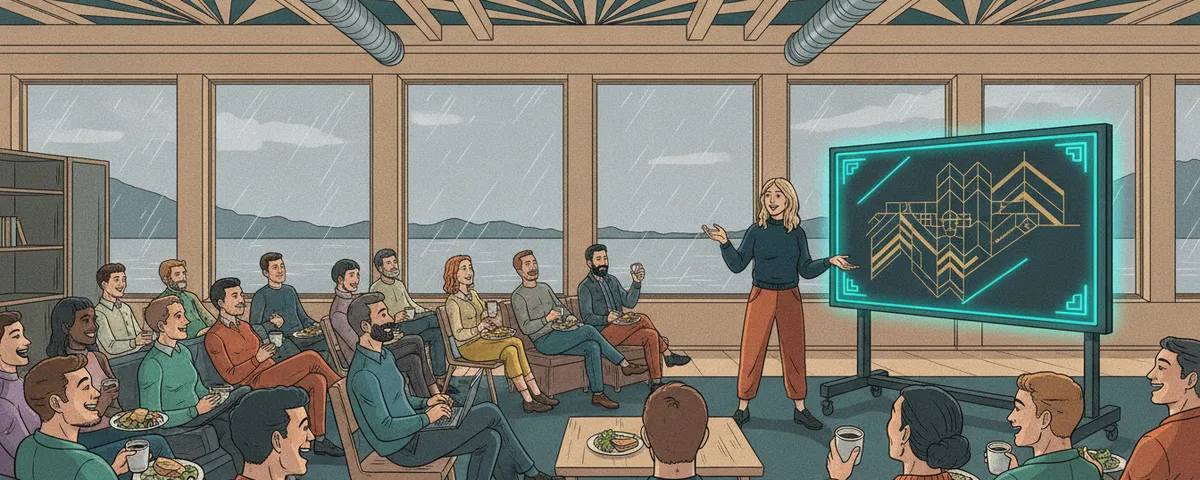
FRI 30 OCT · 1:00PM
Lunchtime Talk: Imagining Future Neighbourhoods Through Immersive Tech
Pervasive Media Studio · hosted by Pervasive Media Studio
registerfree
What's happening: Week of 26 October 2026
Pervasive Media Studio · hosted by Pervasive Media Studio
Jessica Warren (Hoffmann) on a recent collaboration with Bristol City Council that used arts, culture and immersive technology to do neighbourhood visioning in South Bristol - asking residents what a…
Other · Social
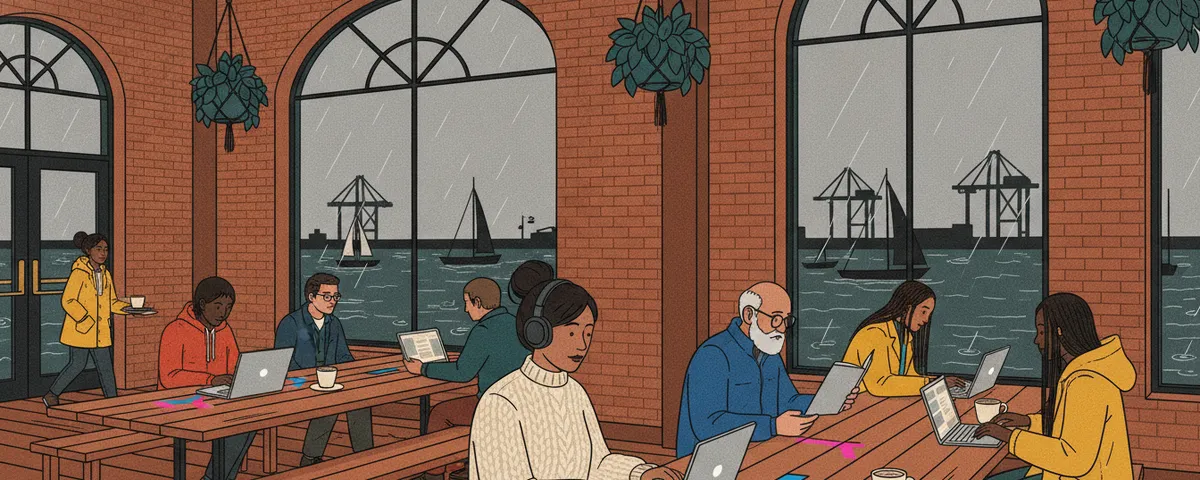
The Friday morning leg of Bristol Co-Workers' standing rota, in the Watershed cafe bar on the harbourside. Writers, software engineers, designers, students and freelancers turn up with laptops from 9:30, work through the morning, break for lunch around noon, and some stay on into the afternoon. No obligation to arrive on time - people join when it suits. Up the stairs from the Watershed cinema entrance and right into the cafe; the group sits on the big table on the raised platform and leaves a stuffed crab out so you can find them. Plug sockets are usually available. Free, on the understanding that you buy something from the cafe while you are there.
Fri 30 Oct · 9:30am · Watershed
The Friday morning leg of Bristol Co-Workers' standing rota, in the Watershed cafe bar on the harbourside. Writers, software engineers, designers, students and freelancers turn up with laptops from 9:30, work through the morning, break for lunch around noon, and some stay on into the afternoon. No obligation to arrive on time - people join when it suits. Up the stairs from the Watershed cinema entrance and right into the cafe; the group sits on the big table on the raised platform and leaves a stuffed crab out so you can find them. Plug sockets are usually available. Free, on the understanding that you buy something from the cafe while you are there. Why go: it is the simplest answer in Bristol to working alone all week, and the Watershed is the best of the three venues the group rotates through. Best for freelancers and remote workers who want company and a change of desk rather than a programme.
SPOTLIGHTDesign · DeepTech
Jessica Warren (Hoffmann) on a recent collaboration with Bristol City Council that used arts, culture and immersive technology to do neighbourhood visioning in South Bristol - asking residents what a place should become, and using immersive tools to let them see it rather than read about it in a consultation document. One of the Pervasive Media Studio's weekly Lunchtime Talks, 13:00 to 14:00 at the Watershed on the harbourside. Free, and part of Open Studio Friday, so you can take a hot desk in the Studio for the rest of the day either side of it.
Fri 30 Oct · 1:00pm · Pervasive Media Studio
Jessica Warren (Hoffmann) on a recent collaboration with Bristol City Council that used arts, culture and immersive technology to do neighbourhood visioning in South Bristol - asking residents what a place should become, and using immersive tools to let them see it rather than read about it in a consultation document. One of the Pervasive Media Studio's weekly Lunchtime Talks, 13:00 to 14:00 at the Watershed on the harbourside. Free, and part of Open Studio Friday, so you can take a hot desk in the Studio for the rest of the day either side of it. Why go: immersive tech in a civic setting is usually pitched rather than reported on, and this is a practitioner saying what actually happened with a real council and real residents. Best for people working in creative tech, civic tech, planning or public-sector innovation.
One email. The week's best events, picked by a person, not an algorithm.
Ten SETsquared Bristol startups pitch live and compete for a Best Elevator Pitch award voted on by the audience, with a further eight companies exhibiting around the room. Pitching companies…
Janine Hirt (Innovate Finance)
The eighth FinTech West annual conference, a full day at We The Curious on where financial services and technology meet in the South West. Keynotes, panels, fireside conversations and a…
A panel discussion with live demonstrations, the chance to meet researchers and a tour of the lab, on how robotics and assistive technologies could make daily life more accessible. The…
Rebel Meetups' monthly Bristol gathering, running since 2013 and now in partnership with techSPARK locally. Casual networking for founders, creators, freelancers and anyone adjacent, with an occasional fireside chat from a founder or business owner. No agenda and no dress code. Drinks at the bar. 18:00 to 20:00 at The Square Club, 15 Berkeley Square. Go in through the main reception of the Berkeley Square Hotel to sign in and they will send you downstairs. Free, underwritten by the venue and volunteer hosts. 24 people signed up, and the group carries a 4.8 rating across 421 reviews. Why go: a thirteen-year run and a techSPARK tie-in mean the room is reliably made of people who actually build things, which is not true of most free networking nights. Best for freelancers and early-stage founders who want a low-stakes first door into the Bristol scene.
Ten SETsquared Bristol startups pitch live and compete for a Best Elevator Pitch award voted on by the audience, with a further eight companies exhibiting around the room. Pitching companies include Attacus Acoustics, Heddle, Hidden Signals, MindsetOS, Nimbus Agri-Tech, Novi and Visible Data; exhibitors include Altrix Labs, Builders AI, GlimpseML and Surveyr. Sectors span healthtech to greentech. Published agenda: 18:00 welcome drinks, exhibition and networking; 18:45 welcome speech; 19:00 elevator pitch competition; 19:30 audience voting and interval; 19:40 Best Elevator Pitch award; 19:45 closing remarks and networking; 20:30 close. Organised by SETsquared Bristol, part of Bristol Innovations at the University of Bristol, and sponsored by law firm VWV and IP firm Stratagem. Free, at the Sloane Robinson Building on the Temple Quarter Enterprise Campus. Registration closes 30 October. Why go: eighteen named companies in one room with a structured pitch slot is unusually high signal for a free event. Go if you invest, advise or want a current read on what Bristol's incubator pipeline is building.
A monthly peer-support meet-up at Pervasive Media Studio for 18-30(ish) creatives who are building a practice or starting out in the creative industries. It runs as a structured conversation rather than a talk: 18:00 what everyone is working on and stuck on, 19:00 goals for the next month and the support needed, 20:00 social and next steps. Hosted by the Watershed Make Shift team alongside Studio Residents and producers, with a route into the wider Pervasive Media Studio community and partners including Creative Youth Network, who run guest speakers and one-to-one mentoring across the programme. Free, and part of Watershed's Tuesday-evening Make Shift strand, supported by Arts Council England and Bristol City Council. Why go: Bristol's creative-tech scene runs on the Studio's network, and this is the cheapest way into it early in a career. Best for 18-30s making immersive, digital or creative work who want producers and residents to look at it; not a room for established practitioners.
CodeHub Bristol's fortnightly social coding evening at DeskLodge House. People bring a side project, something they want to study, or a set of coding challenges, and work on it alongside others, solo or paired, in any language and at any level. The agenda is 18:00 gather on the ground floor, 18:30 intros, 18:45-20:15 hacking, 20:30 close. Hosted by James R., Stephen Leach and Ray for CodeHub Bristol, which also runs workshops, mentorships and study groups and keeps a #hacknight channel on its Discord. Bring a laptop. Reception closes after working hours, so arrive by 18:30 or you may not get in. Free; 8 signed up at the time of writing. DeskLodge hosts as the regular sponsor. Why go: the most reliable low-pressure room in Bristol for developers who want company while they work rather than a talk to sit through. Best for anyone with a stalled side project, and genuinely fine for beginners.
with Ben Seiler (Speaker, Bristol WordPress Meetup Group)
Ben Seiler on why polished, fast WordPress sites still fail to convert, and why the fix is usually positioning rather than the theme or the plugin stack. He works through the Value Proposition Canvas - what customers are actually trying to get done, what is blocking them, which arguments land - and then translates that into a page structure you can build section by section. Real before-and-after examples, a short hands-on exercise on one of your own projects, and a reusable page template to take away. Temple Studios, doors 6:30pm, free, refreshments provided. The group runs monthly and keeps a no-show policy because they order food in advance. Why go: it is the rare WordPress night that treats the site as a commercial problem rather than a build problem. Best for freelancers and agency teams who ship client sites and keep getting asked why the traffic is not converting.
Bristol AI Shed at Engine Shed on what AI changes about leading, developing and looking after people at work: how roles evolve, how to build confidence rather than anxiety, and what good leadership looks like when half a team is working alongside AI tools. Psychologist and coach Ed Cornfield, co-founder of MindsetOS, opens with a keynote on the mindsets that help people and teams adapt under uncertainty. A panel of practitioners then gets into what is actually working inside organisations right now and what is not. It closes with networking and hands-on demo stations showing AI tools built for people teams. Doors 08:15, programme 08:45 to 11:20. Aimed at HR directors, People and Culture leads, L&D professionals and business leaders. Ages 18 and over. Why go: most Bristol AI mornings are for the people building the tools. This one is for the people who have to carry a workforce through them. Best for anyone responsible for hiring, development or change.
A monthly morning session for female founders and business leaders at the Bristol NatWest Accelerator. This edition is a wellbeing workshop rather than a business clinic: why being present matters when you are running a company, simple seated yoga movements that need no equipment, a guided mindfulness exercise, a reflective journaling activity on what self-care means to you, and practical ways to carry calm back into work. Led by Katie Hodge, founder of Zenaa, who has created more than 50 retreats across the UK, Europe and Sri Lanka and founded Zenaa Online. Runs 10:00 to 12:00 at the NatWest Accelerator on Avon Street, with networking either side. Free. NatWest notes the content is for information only and is not individual advice. Why go: the draw is the room, not the curriculum, and it is one of the few recurring women-founder spaces in Bristol with an accelerator behind it. Go for the peer contact and the hour off founder mode; skip it if you want fundraising or growth tactics.
A panel on how the West of England turns green investment into local jobs and energy security, run by UWE Bristol's Sustainability Team with the South West and Wales Young Professionals branch of the Energy Institute. The evening doubles as the launch of UWE's MSc Sustainable Technology, and a good part of the discussion is about what the 2050 regional energy workforce looks like and who trains it. Networking drinks from 17:00 in the Z Block atrium, panel at 18:00 in room 3Z015, close at 19:00. Free, at Frenchay Campus. The organisers ask people to come by bus or bike and run a booking form for the few parking spaces. Part of UWE's Green Fortnight. Panellists were not named at the time of listing. Why go: cleantech skills and hiring in this region get discussed in policy documents far more often than in a room with the Energy Institute and a university engineering school in it. Best for engineers, sustainability leads and people weighing a move into energy.
A two-hour workshop on getting a CRM working properly: what to track, how to organise leads, and which sales numbers actually tell you something. The Accelerator team hands out a CRM template to work from, and the session covers sales performance indicators, how to build your own CRM and a Q&A with their experts, with founders describing what has worked for them. It is followed by an Action Lab hour where you implement one change with the team and the other founders in the room rather than taking notes home. There is pre-work: download the NatWest Accelerator app and join the Bristol Sales Accelerator group, which is approval-gated. Free, at 2 Avon Street. Why go: most sales advice stops at the principle. This one ends with your CRM actually changed. Best for founders still running sales out of a spreadsheet.
An hour with IAAPS, the University of Bath's propulsion and automotive research centre, on using simulation and system modelling to test an idea before building the hardware. The pitch is evaluating concepts earlier, cutting development risk, and having evidence for funders and customers that does not depend on a physical prototype existing yet. Worked examples of comparing concepts, understanding real-world performance and building a case for investment. Aimed at founders and technology businesses developing new products, systems or technologies. In the Hawking meeting room at Future Space, UWE North Gate, Filton Road. Free. Why go: digital engineering is the kind of capability regional manufacturers are entitled to use and mostly do not know is there. Worth an hour if you are building anything physical and burning money on prototypes.
An hour of pitch practice at the NatWest Accelerator on Avon Street, covering how to talk to potential customers, how to pitch investors, and how to tell the story of the business so that people stay with it. It is a standing Accelerator session rather than a one-off, so the format is short input and then work on your own pitch. Spaces are limited and it is free. The published detail is thin: there is no named coach or speaker on the listing, and no agenda beyond those three headings. Why go: pitching only improves by doing it out loud in front of people who will tell you where they lost interest, and there are few free rooms in Bristol that offer that. Best for early-stage founders who have a deck but have not yet had to defend it.
A panel discussion with live demonstrations, the chance to meet researchers and a tour of the lab, on how robotics and assistive technologies could make daily life more accessible. The conversation spans rehabilitation, mobility, AI and assistive robotics, and asks who gets to shape these technologies and whether people trust them. UWE Bristol hosts at the Bristol Robotics Laboratory, marking the lab's 20th anniversary, as part of the Bristol Distinguished Address Series and Being Human Festival 2026. Registration opens at 18:00 in the foyer, the panel starts 18:30 in Waterside 3, Q&A at 19:15, the programme ends 19:45, then networking and drinks until 21:00. No speakers are named on the listing. Free. Step-free access, accessible toilets, assisted listening, quiet spaces and captions are provided, and filming takes place for UWE promotional use. Why go: the demonstrations and the lab access are the real draw, and the accessibility framing keeps the robotics grounded in who it is actually for. Best for people working in assistive tech, health robotics or inclusive design.
with Janine Hirt (Chief Executive, Innovate Finance)
The eighth FinTech West annual conference, a full day at We The Curious on where financial services and technology meet in the South West. Keynotes, panels, fireside conversations and a FinTech pitch showcase, with sessions across AI, smart data, cyber security and funding. The agenda is now near-complete and published on the FinTech West site. Janine Hirt, CEO of Innovate Finance, is confirmed as a keynote. Eight fintech founders pitch in this year's Showcase; the organisers have not named them yet. Nearly 500 people have registered. S&W returns as primary sponsor, with PEXA and Howden new this year and Birketts LLP as conference partner. Free, 09:30 to 15:00, with an optional donation at registration. It falls on the Friday before BRAZEN week, Bristol's tech festival. Why go: the one day a year the region's fintech community is in a single room, and the national policy view turns up with it. Best for fintech founders, product and risk leads, and investors with South West interests.
The Friday leg of Bristol Co-Workers' weekly rota, in the Watershed cafe bar on the harbourside. People arrive with laptops from 9:30, work through the morning side by side, break for lunch around noon, and some carry on into the afternoon. Writers, software engineers, designers, students and freelancers all turn up, and arriving at 9:30 is a suggestion rather than a requirement. Up the stairs from the Watershed cinema entrance and right into the cafe bar; the group takes the big table on the raised platform and leaves a stuffed crab out so you can spot them. Good WiFi and plug sockets. Free, on the understanding that you buy something from the cafe. Why go: the lowest-commitment way into Bristol's freelance and developer scene, and the Watershed is the best of the venues the group rotates through. Best for remote workers who want company rather than a programme.
Annabel Gillard (LSE FORGOOD / Conversations on AI) · Su Crighton (KPMG) + 3 more
An interactive panel on who decides what AI does to people, communities and work, and whether Bristol's own habits give the city a distinctive voice in that argument. Part of…
A one-day hackathon where teams of women use AI and real data to build tools that make the gender pay gap more visible and solvable. The rules are strict about…
The last Bristol AI Shed of 2026, in the Watershed cinema, built around what actually worked this year rather than what might. Doors 08:30 with coffee and breakfast, introductions and…
with Liam Maxwell (Former UK Government Chief Technology Officer, ) · Ric Hill (, Ghyston) · Emily Hill (, Ghyston) + 5 more
The opening morning of the Brazen Summit: four sessions for senior technology and business leaders on where technology investment is paying off and where it is not. It starts with the launch of Ghyston's State of Tech Leadership Report 2027. Ric Hill and Emily Hill present the findings, then a panel chaired by Sam Deacon, with Sue Turner OBE, Richard Potter and Tom Heath, tests them against practice. The second half turns to execution: a fireside chat between Ric Hill and Mike Whitehead on modernising legacy systems without stopping the business, then Liam Maxwell, the UK government's first Chief Technology Officer, closing with a keynote on risk, regulation and resilience. 09:30 to 12:30 at St Nicholas Church. Paid; techSPARK has not published a face price. Why go: this is the CTO and board room of the festival, and Maxwell is a first-hand account of running technology at state scale. Best for technology leaders, CIOs and non-executives.
A minibus tour of three Bristol companies that build physical technology, run as part of techSPARK's Brazen festival. Roughly half an hour inside each of Open Bionics, WASE and Smartbox. The organisers put the range as bionic arms through to compact fusion reactors, and the point is to see the labs and talk to the people who work in them. Itinerary: 9:30 Open Bionics (BS1 2NB), 10:10 WASE (BS5 0SP), 11:05 Smartbox (BS1 5PU), ending at 11:30. The bus starts at Open Bionics and finishes at Smartbox rather than returning, so plan the journey on from BS1 5PU. Places are limited and two further identical tours run later the same day. Why go: working labs are not usually open to visitors, and this is the quickest way to see what Bristol actually manufactures. Best for engineers, hardware founders and anyone hiring into deep tech.
A minibus tour of three Bristol companies that build physical technology, run as part of techSPARK's Brazen festival. Roughly half an hour inside each of Open Bionics, WASE and Smartbox. The organisers put the range as bionic arms through to compact fusion reactors, and the point is to see the labs and talk to the people who work in them. Itinerary: 12:00 Open Bionics (BS1 2NB), 12:40 WASE (BS5 0SP), 13:35 Smartbox (BS1 5PU), ending at 14:00. The bus starts at Open Bionics and finishes at Smartbox rather than returning. This is the middle of three identical tours on the day; the others run at 9:30 and 14:30. Places are limited. Why go: working labs are not usually open to visitors, and this is the quickest way to see what Bristol actually manufactures. The midday slot is the one to pick if you want to keep the morning free. Best for engineers and hardware founders.
with Katie Martin (, Hidden Signals) · Duniya Moore (, Illumo Digital)
A 25-minute session on what changes when you stop doing the work and become responsible for the people doing it. Two people who reached the CEO seat from opposite directions compare notes. Katie Martin of Hidden Signals moved from finance into the top job. Duniya Moore of Illumo Digital went from CEO to co-owner, and had to lead founding partners rather than a team she had built herself. The brief is the specifics rather than the principles: what broke, what worked, and what they would tell themselves on day one. Part of Brazen's Community Track at The Station, 13:35 to 14:00. Why go: two different routes into the same chair, which is rarer than it sounds, and short enough to fit around the rest of the festival. Best for first-time founders and anyone about to start managing instead of doing.
with Christopher Penfold (Commercial Director, ForrestBrown) · Kate Sikora (Managing Partner, Noble Performance) · Tom Harber (, Aer Studios)
A 50-minute panel on why founders choose to build in Bristol, and what keeps them here once they could go anywhere. On stage: Christopher Penfold, Commercial Director at ForrestBrown; Kate Sikora, Managing Partner at Noble Performance; and Tom Harber of Aer Studios. The framing is the city rather than any one company - what Bristol offers ambitious businesses that other places cannot, from its creative industries through to its deep-tech side. Part of the Brazen Community Track, at The Station on Silver Street. Why go: three people who have each made the stay-or-go decision from a different vantage point, in under an hour. Useful if you are deciding where to base a company, or if you spend your time persuading other people to base theirs here.
A minibus tour of three Bristol companies that build physical technology, run as part of techSPARK's Brazen festival. Roughly half an hour inside each of Open Bionics, WASE and Smartbox. The organisers put the range as bionic arms through to compact fusion reactors, and the point is to see the labs and talk to the people who work in them. Itinerary: 14:30 Open Bionics (BS1 2NB), 15:10 WASE (BS5 0SP), 16:05 Smartbox (BS1 5PU), ending at 16:30. The bus starts at Open Bionics and finishes at Smartbox, and this tour is followed by casual drinks at Smartbox. Places are limited; the same tour also runs at 9:30 and 12:00. Why go: working labs are not usually open to visitors, and of the three tours this is the one with drinks at the end, which is where the conversations actually happen. Best for engineers, hardware founders and anyone hiring into deep tech.
with Helene Jewell (Owner and Director, Jewell Facilitation) · Rachel Jannaway (Founder and Director, Jannaways)
Four speakers, one slide and ten minutes each, on leading through change, uncertainty and new technology, with an open Q&A at the end. Helene Jewell of Jewell Facilitation opens with what a six-person relay swim of the English Channel taught her about holding a team together when conditions keep changing. Rachel Jannaway of Jannaways follows with 'Human in the Lead, Not the Loop': whether the person you have named as accountable for an AI system actually has the authority to stop it. Two further talks complete the hour. Run by Bristol Creative Industries at The Station as part of Brazen. Why go: ten-minute slots force one point made properly, and the AI-accountability question is the one most organisations have answered on paper only. Best for team leads and founders who have started delegating to systems rather than people.
The last Bristol AI Shed of 2026, in the Watershed cinema, built around what actually worked this year rather than what might. Doors 08:30 with coffee and breakfast, introductions and AI show-and-tell from guests at 09:10, then a panel at 09:35 on where AI made a real difference in people's work and businesses, and where it did not or should not. Demo stations run alongside. On the panel: Kian Bakhtiari, founder of The People and a Forbes writer; David Sequiera, Global Executive VP at Skai; and Abby Salmon, UK&I People and Talent Partner at First Table. Co-founders Jake Hewlett and Stephen Honight host. Sponsored by VWV and Albert Goodman. 18+, breakfast included, and the organisers expect it to sell out. Why go: the panel brief is unusually honest for an AI event, with what didn't work getting airtime. Best for Bristol professionals putting AI into day-to-day work rather than building models.
An interactive pitching workshop from the NatWest Accelerator's Bristol hub, aimed at founders about to go out for funding. The session treats a pitch as storytelling rather than a deck: how to structure it, what makes a story stick, and what an investor is listening for. You pitch on the day and get feedback in the room, and the organisers work in the neuroscience of memory alongside examples from founders who have reworked their own messaging. Speaker names had not been published at the time of writing. Free, 10:00 to 12:30 at the Accelerator Hub on Avon Street. Attendees are asked to download the NatWest Accelerator app and join its Funding Group first. Why go: practising the pitch in front of people who hear them professionally beats rehearsing alone, and this is the free session in Bristol this month that gives you the floor. Best for first-time founders heading into a raise.
with Richard Godfrey (, Rocketmakers) · Adam Walker (, Rocketmakers) · Matt Harris (, Rocketmakers)
Rocketmakers on the gap between an AI-generated prototype and something you can ship. They took one of their own AI-built prototypes through to a deployable system, and will go through what broke, how they fixed it, and how they now design, build and deploy software in an AI-first world. Then it turns into table work: you join the table matching where you are - yet to try AI coding, sitting on a prototype and unsure what next, or already running something live - and work through it with Rocketmakers staff. Richard Godfrey, Adam Walker and Matt Harris are leading. Places are capped at around 30, and it is aimed at founders and corporate innovators rather than professional developers. Why go: the hard part of vibe-coded software is everything after the demo, and this is a working session on exactly that rather than a talk about it.
with Patrick Fraser (Head of Brand and Reputation, AMBITIOUS) · David Sloly (Founder, HarveyDavid) · Rebecca Steer (Partner, Keystone Law) + 1 more
An hour on what AI assistants say about your company when a customer, prospect or investor asks, and who controls that. The premise is that for a growing share of people the first introduction to an organisation is now a generated answer rather than its website or press coverage, and most companies have little visibility into how those answers are formed. Hosted by Patrick Fraser, Head of Brand and Reputation at AMBITIOUS, with a panel of David Sloly, Founder of HarveyDavid; Rebecca Steer, Partner at Keystone Law; and Greg Halse, Technology Lead at AMBITIOUS. Further speakers were still to be announced. At Our Media's office in Eagle House on Colston Avenue. Why go: the legal and reputational side of AI-generated answers gets far less airtime than the engineering, and there is a practising lawyer on the panel. Best for founders, marketing leads and comms people.
A two-hour working session on fixed versus growth mindset as it actually shows up in founders: how setbacks get handled, and how to treat advice and rejection as data you can test rather than verdicts. You bring one business task you have been avoiding and leave with a small experiment to run on it. Run by SETsquared Bristol and led by Jason Nichols, its Incubation Manager, a business coach who founded and exited the FMCG brand New Kings Coffee and has logged over 750 hours coaching more than 200 entrepreneurs. The format is deliberately interactive, mixing solo reflection, pair work and small-group discussion rather than slides. 14:00 to 16:00. Free, in person at the Sloane Robinson Building on Cattlemarket Road. Why go: mindset workshops are easy to dismiss, but this one is anchored to a concrete task and run by someone with an exit and real coaching volume behind him. Useful for early-stage founders stuck on a decision rather than on a product.
Make it Clear and Bluefuse on where AI genuinely speeds up digital delivery and where it still needs a person's judgement. The two agencies have worked together for over ten years - Make it Clear on branding and user-centred design, Bluefuse on building and running custom software - so the argument comes from people shipping client work rather than from a platform vendor. It ends with a live audience challenge: bring a business or digital product idea and they will work it through with AI in front of the room, limitations included. At Our Media, Eagle House, Colston Avenue, in the Brazen Community Track. Why go: the live challenge is the reason to turn up. Most AI sessions stay abstract; this one commits to being wrong in public. Best for product and design people, and founders about to spend money on a build.
with Annie Legge (CEO, Tech4Good SW)
A panel on whether Bristol can lead on AI in a way that matches the city's politics rather than just its compute. Bristol already hosts Isambard-AI, one of the world's most energy-efficient supercomputers, and the question here is what that should mean for everyone else. Charity and social-purpose leaders, researchers and technologists discuss early findings on what stops social-purpose organisations adopting smaller, lower-impact language models, what the sector sees as the risks and opportunities, and how one Bristol charity uses AI day to day. Annie Legge, CEO of Tech4Good SW, is on the panel. At The Station, 16:00 to 17:00, part of Brazen. Why go: small-model adoption is where cost, carbon and capability actually meet, and this is the rare room asking charities rather than vendors. Best for anyone deploying AI on a tight budget.
with Annabel Gillard (Founder, LSE FORGOOD / Conversations on AI) · Su Crighton (Partner, KPMG) · James Hobbs (CTO, Aer Studios) + 2 more
An interactive panel on who decides what AI does to people, communities and work, and whether Bristol's own habits give the city a distinctive voice in that argument. Part of Brazen's Community Track. AI ethicist Annabel Gillard, founder of LSE FORGOOD and the Conversations on AI podcast, hosts. On the panel: Su Crighton, Partner at KPMG, on turning AI investment into measurable outcomes; James Hobbs, CTO of Aer Studios, on digital sustainability and responsible AI; Emmy-nominated documentary producer Vicky Matthews on AI in factual production; and Lisa Minogue-White of Immersive. The format pulls the audience in rather than keeping them in rows. 17:30 to 19:30 at KPMG's Queen Square office. Tickets zero to twenty pounds, pay what you can. Why go: it is the one Brazen room with a KPMG partner, a CTO and a film-maker arguing about AI ethics at the same table, and no technical background is needed. Best for anyone whose work is about to be reshaped by AI rather than built with it.
The third in Electra's run of five dinners for women running companies in and around Bristol, this one loosely themed on leadership. A table of founders, good food, and a firm no-pitching rule - the evenings are for founders and co-founders only, and Electra is explicit that they are not a place to sell services. Tickets are 7.50 GBP as a contribution towards the food, and the event is sold out on Eventbrite. The exact address is shared on registration; it is central Bristol, BS1. Supported by Birketts, S and W, Micrima, Bristol Innovations, Kapel Consulting, the West of England Women's Commission and TechSPARK. Note the organiser's own copy says 'this third dinner, on 24 November' while the listing header says 10 November. Why go: small, closed and deliberately unglamorous - the format where founders say what is actually going wrong. Best for women founding or co-founding in the Bristol region who want peers rather than an audience.
South West Data's monthly social, upstairs in the Watershed cafe and bar on the harbourside, clustered around the peninsula bar on your right as you come in. There is no programme: no talks, no slides, just people who use, build with or are learning data technologies in the South West, from 19:00 until about 22:00. The group has 1,683 members and the socials run small - recent ones have drawn three to six - so it is a conversation, not a room. Free, RSVP on Meetup. Second Tuesday of every month, so if you miss it the next is 8 December. Why go: Bristol's data community is well served for talks and badly served for unstructured time, and this is the fixture that fills the gap. Best for data engineers, analysts and ML people who want to compare notes without a speaker in the way.
with Kester Brewin (Associate Director, Institute for the Future of Work)
Kester Brewin, Associate Director at the Institute for the Future of Work, on what AI is doing to jobs: which ones are changing, what it means for people entering the workforce, and what five centuries of anxiety about intelligent machines tell us about this round. Part of Brazen's Community Track. Brewin draws on his book GODLIKE: A 500-Year History of Artificial Intelligence in Myths, Machines, Monsters. He has written for the Guardian and presented on BBC Radio 4, and the evening is built to be funny and highly participatory rather than a lecture. Doors 18:30, talk 19:45 to 22:00 at Dareshack. Tickets zero to twenty pounds, pay what you can. AI West run their Conversations on AI panel at KPMG earlier the same evening, a short walk away. Why go: the jobs question usually gets handled by economists or by vendors. This is a researcher who studies work for a living, in a room that wants arguments back. Best for students, career-changers and anyone managing a team through this.
A business breakfast at UWE Bristol's Future Space on the Frenchay campus, about the routes small companies actually use to pull expertise and money out of a university: Knowledge Transfer Partnerships, industrial PhDs, consultancy and contract research, and the innovation funding around them. A 30-minute overview from 09:15, then guest presentations and Q&A from regional businesses that have been through it, then networking to 11:30. Free, pastries and coffee from 09:00. Parking needs a vehicle registration submitted at least 48 hours ahead and is first come, first served. Future Space is step-free and wheelchair accessible. Why go: KTPs and industrial PhDs are among the cheapest R&D capacity a small company can buy, and almost nobody outside the universities knows how to start one. Best for technical founders and R&D leads in the region with a problem they cannot staff.
with Louise Whitaker (Circular Economy Lead, Virgin Media O2)
A 30-minute panel on the roughly 400 million unused devices sitting in UK drawers, around 40 per cent of them reusable, set against the 1.5 million people with no access to a device at all. The framing is that reuse is a coordination problem rather than a business-model one: getting the right hardware to the right people, safely and locally. Speakers come from telecoms, secure data handling and the local community, including Louise Whitaker, Circular Economy Lead at Virgin Media O2; techSPARK says more are to be announced. The discussion covers what holds reuse back, from data-security fears to missing infrastructure, and where the West of England could lead. At The Station, part of Brazen. Why go: a concrete logistics problem with real numbers and an operator in the room, not a general sustainability session. Best for IT asset, hardware and social-impact teams.
with Kierra Box (Campaigner, Friends of the Earth) · Mayra Rodriguez (Research Fellow, AI & Data Science, University of Exeter) · Rory Murphy (Postdoctoral Research Associate, University of Exeter)
Three researchers and campaigners on what the data-centre build-out behind the AI boom is doing to energy, water and the communities next door. Kierra Box of Friends of the Earth on access to information and the Stop Dirty Data Centres campaign; Mayra Rodriguez of the University of Exeter on using AI for climate and health while accounting for its own footprint; Rory Murphy, also Exeter, on impacts drawn from the public-engagement record of the UK's largest approved data-centre planning application. Doors 18:00 at The Foundation, lower ground floor of the Triodos building on St George's Road. Talks from 18:45, Q&A 19:45, pub afterwards. Free; 91 attending with 29 places left at the time of writing. Part of the Brazen Festival's Clean day. Why go: the infrastructure argument about AI is usually had in slogans, and this is three people with primary evidence. Best for anyone building on AI who will be asked to defend its footprint.
with George Proud (, Gendo) · Tomas Millar (, Millar + Howard Workshop)
Two talks on what generative AI is doing to architectural practice, from image generation at the front of a project through to what actually gets built. George Proud of Gendo covers how generative AI is changing architectural visualisation and creative workflows. Tomas Millar of Millar + Howard Workshop takes the wider question of what AI means for the profession, creativity and craft. RIBA Bristol & Bath host. Doors open 17:45 for an 18:00 start, the talks run into questions and open discussion, then drinks and informal networking until 20:30. Paid: general admission is £8.00 and a student ticket £4.00, before Eventbrite fees. No refunds, and ticket sales close at midday on 10 November. Why go: the pairing is the point, one speaker building the AI tools and one interrogating what they do to the craft, so it should be less credulous than most AI panels. Go if you work in architecture, design tech or visualisation.
Bristol AI Automations' monthly meetup, built around two live demos rather than talks - people showing automations they have actually wired up, then questions. Arrive 18:00, intro 18:15, first demo 18:20, break, second demo 19:00, Q&A 19:30, networking from 20:00 until the building closes. At DeskLodge House, 2 Redcliffe Way; press the buzzer and ask reception for the AI Automations meetup, because several tech groups use the building the same night. Free, 16 signed up with 34 places left at the time of writing. Demo subjects are announced close to the date. Why go: most AI meetups in the city are discussion; this one makes someone open the tool and show the thing running, which is where you find out what actually works. Best for operators and engineers wiring AI into real workflows.
PHPSW's last meetup of the year, given over to lightning talks of around ten minutes each. The call for speakers is still open, so the running order is not published yet; the suggested subjects are an AI product you actually use, anything in PHP and the wider ecosystem, or a good story from a Wednesday. Doors from 18:30 with food free thanks to the sponsors, welcome and community announcements at 19:00, talks from about 19:05, finishing around 20:30, then drinks. Lamp Bristol and Temple Studios are hosting. PHPSW has run for years and has about 1,350 members. Why go: an established Bristol engineering community on its end-of-year night, and the lightning format means you hear from working developers rather than a booked speaker. Best for PHP and web developers, and anyone who wants the local engineering scene without a conference ticket.
A one-day hackathon where teams of women use AI and real data to build tools that make the gender pay gap more visible and solvable. The rules are strict about output: something real and usable, not a concept note or another coaching app. Morning to form teams and pick an angle, afternoon to build with mentors, late afternoon for pitches, judging, prizes and drinks. Presented by SW*AID, the South West and Wales women in AI and data community, with Taught by Humans and Bristol law firm Ashfords co-organising. Part of the Brazen tech festival, at Hargreaves Lansdown, 09:00 to 17:30. Free but approval-gated: applications close 15 October, decisions the week of 19 October. Open to women based in the South West or Wales who are free all day. No tech background needed. Around 40 places. Why go: one sharp problem and a hard no on vapourware, which is rarer than it sounds. Go if you want to ship something in a day with mentors on hand, whatever your level.
with Tilly Lockey (Keynote, ) · Guy Singh-Watson (Founder, Riverford) · Gaynor Coley (, ) + 5 more
Day 4 of the Brazen Summit, aimed at founders, scale-up leaders and the people who back them: growing without diluting what the company is for, and getting ready to exit. Tilly Lockey opens with a keynote. Guy Singh-Watson, founder of Riverford, is then in conversation with Gaynor Coley on building an impact-led business on his own terms. Simon Davies, Chief Test Pilot at Vertical Aerospace, follows with what it takes to design, test and certify a new aircraft, and the scaling lessons that travel beyond aerospace. The morning closes on first-hand accounts of acquisitions, mergers and IPOs from Nick Sturge MBE, Heather Frankham MBE DL, George Sandilands and Lauren Crawley-Moore of the London Stock Exchange. Paid; no face price published. Why go: the closing panel is four people who have actually been through an exit, which Bristol rarely gets in one room. Best for founders past product-market fit and their investors.
A 90-minute morning session on who is being shut out of digital access across the South West, and the risk that AI widens rather than narrows that gap. It opens with headline findings from The Connection Project's new national report and what they mean regionally, then AbilityNet on accessibility and AI, then short talks from local government, grassroots projects and businesses. Tech4Good South West presents, hosted by Annie Legge, in partnership with The Connection Project and AbilityNet, as part of the Brazen festival. The second half is facilitated conversation on what is already working and where collaboration could happen. 10:00 to 11:30 at RWK Goodman's Bristol office. Individual speakers are not named. Free. Guest details are shared with Brazen. Why go: it puts councils, charities and tech businesses in one room with actual research rather than opinions, and the facilitated half makes it more than a talk. Go if you build public-facing products or fund digital inclusion work.
with Bruce Gray (Founder and Chairman, Left Handed Giant)
A 25-minute founder session with Bruce Gray, who started Left Handed Giant brewing in borrowed tanks and now runs eight Bristol venues, backed by around 1,500 crowdfunding investors and certified as a B Corp. The subject is scaling without giving up the principles the business was built on: raising money from your own community rather than institutions, the trade-offs growth forces, and why being held to a higher standard has made the company stronger rather than slower. At The Station, 13:00 to 13:25, part of Brazen's Community Track. Why go: community equity is a route most founders here have only read about, and this is someone 1,500 shareholders deep in it talking about the obligations as well as the money. Best for founders weighing crowdfunding against a conventional raise.
Knowle West Media Centre's monthly meet-up for people mixing community, arts and technology. This month it teams up with the Bristol Neurodivergent Artist Network for a screening of The Stimming Pool, a 70-minute experimental hybrid film by the Neurocultures Collective and filmmaker Steven Eastwood. Buffet dinner and arrivals from 18:00, the film in two halves with a break, then a discussion and an optional tour of KWMC's Making Space (laser cutter, 3D printer, sewing machines). Two hours, in person at Leinster Avenue, Knowle West, BS4 1NL. Dinner is included. Fidget toys and a quiet room are provided; raise access and dietary needs when booking. Why go: a Bristol tech room that starts from people rather than product, with a proper maker space to look round afterwards. Best for creative technologists and community-minded builders.
The South West edition of the UK Dynamics 365 and Power Platform User Group: two 45-minute talks on building and running Microsoft's low-code business stack, from people who work with it day to day. The group has just moved to Changing Social at St Bartholomew's House on Lewins Mead, round the corner from Bristol Beacon. Doors 6:30, two speaker slots, food and drinks provided, and a social afterwards for anyone who wants to stay. The November line-up was still being confirmed when this was written. Free, 41 places left at the time of checking. Why go: the only regular Bristol room for people actually shipping Dynamics 365 and Power Platform work — admins, consultants and makers who want to swap real implementation notes rather than sit through a vendor deck. Worth the evening if Microsoft business apps are the day job.
A 90-minute workshop from Aer Studios and UX Crunch on hiring for skills that did not exist when the job description was written. The first half is talks on the changing skills landscape, what younger candidates want from employers, and what businesses actually need from the next generation. The second half is the work: as a group you take a conventional role and redesign it for the workforce you need next - what experience is genuinely essential, what can be taught, which skills matter most, and whether your recruitment process is helping you find the right people or filtering them out. At The Station on Silver Street, in the Brazen Community Track. Why go: you leave with a rewritten job spec rather than a view, which is more than most hiring sessions manage. Best for founders doing their own hiring and people leads in small tech teams.
with Amy Gettings (Managing Director, Hey! What?) · Hamish McWhirter (Creative Director, Hey! What?)
A 25-minute talk from Hey! What? on what brands can take from subcultures, festivals and scenes. The argument: culture does not move because something is sensible, it moves because something is different enough to notice, specific enough to believe in and interesting enough to pass on - so weird is not the opposite of strategy, it is often where strategy starts working. Amy Gettings, Managing Director, and Hamish McWhirter, Creative Director, are both speaking. At The Station on Silver Street, in the Brazen Community Track. Why go: short, and a real point of view rather than a case-study reel. Best for marketers and founders who keep producing work that is correct and ignorable.
with John Lanyon (Creative Partner, Studio Lanyon)
Four ten-minute talks from Bristol Creative Industries on getting people to care about complex products, with an open Q&A at the end. John Lanyon, Creative Partner at Studio Lanyon, opens on the psychology of why people decide emotionally rather than logically, using well-known tech campaigns to show it working, and finishes on something to try the next day. A second talk tackles the brand-building catch-22: a weak brand means low demand, low demand means every pound goes on squeezing sales out of that demand, which leaves nothing to invest in brand. Two further talks complete the session. At The Station, 15:00 to 15:50, part of Brazen. Why go: marketing advice for technical founders is usually either pure tactics or pure theory, and this hour aims at the gap. Best for founders doing their own marketing.
An open afternoon at SETsquared Bristol's incubator for tech entrepreneurs and university researchers who are not members yet. The point is to see inside the programme before applying: what the…
Festival of Economics brings FT work columnist Sarah O'Connor to Cinema 1 at the Watershed with a sharper version of the automation question: not that people are losing jobs to…
An evening gathering of the industrial and product design community, run as a Movember fundraiser. The listing is honest about how light the format is: the only agenda item published…
An evening gathering of the industrial and product design community, run as a Movember fundraiser. The listing is honest about how light the format is: the only agenda item published is "drink, pizza, go home", and no talks, panels or speakers are listed. Hosted by Brad at Design Truth, the industrial design community that runs informal city meetups for in-house designers, consultancies and students. It runs for five hours, 18:00 to 23:00, at Tobacco Factory Theatres in Southville. Arriving with a moustache is, in the organiser's words, "not essential but encouraged". Tickets are 13.55 pounds including the Eventbrite fee, and the refund policy is no refunds. Why go: this is a bar-and-pizza evening, not a programme, so go for the room rather than the content. Worth it if you design physical products in or around Bristol and want three hours of unhurried shop talk with people who do the same work; skip it if you need takeaways.
Join industry leaders, port operators, logistics providers, technology innovators, policymakers and sustainability professionals
with Sikandar Nawaz (Principal Data & AI Engineer, Aviva) · Ellie Haines (Data Engineer, Aviva) · Tom Puffit (Head of Data Analytics, Audley Travel)
A quarterly data and AI meetup, this edition hosted inside Aviva's North Bristol offices, with the engineers who built the things doing the talking. Sikandar Nawaz, Principal Data and AI Engineer at Aviva, and Ellie Haines, Data Engineer, open with what Aviva has actually shipped on AI and agentic AI projects. Tom Puffit, Head of Data Analytics at Audley Travel, follows; his topic was still to be confirmed at the time of listing. Welcome drinks from 17:30, talks from 18:00, running to 20:30. Free, with free parking on site. DataCurious is part of the TekCurious community run by Peaple Talent, which draws a mix of large UK PLCs, scale-ups and startups. Why go: in-house engineers describing production AI work inside a large insurer is a harder thing to find than a vendor demo or a founder story. Best for data engineers, analytics leads and anyone deciding whether agentic AI is real yet.
Bristol AI Ethics' monthly evening of talks and discussion on how AI actually gets used — and where that goes wrong — at Torchbox on Colston Street. This month: arrival and networking from 6, a news roundup at 6:30, then Hugh Williams on "responsibility gaps" in care-sector AI — when an automated system causes harm, who or what do we hold responsible, why the gap exists, and whether design can ever close it. Q&A and discussion follow, then drinks and a "positive actions" wrap by 8, with more conversation until the building closes at 8:30. Free; 18 places left when checked. Why go: one of the few Bristol rooms where the ethics conversation stays concrete — a real case and a real speaker to push back on, not abstractions. Best for anyone building or deploying AI who wants to think past the demo.
CodeHub Bristol's fortnightly social coding night at DeskLodge House on Redcliffe Way. Bring a laptop and a project — a side thing on the back burner, something you want to learn, or an online challenge to work through — and spend the evening on it alongside other people doing the same. The shape is simple: gather and socialise from 6, intros at 6:30 (arrive by then, as reception closes after hours), then heads-down solo or paired hacking until around 8:15. All languages, all levels, complete beginners included. DeskLodge hosts and sponsors it, and there's a #hacknight channel on CodeHub's Discord. Why go: the most reliable way to make real progress on the project you never find time for, in a room where a beginner question gets a straight answer. Best for anyone who codes, or wants to start, and gets more done with company.
A public lecture from the University of Bristol's Digital Futures Institute on how AI chatbots are moving into the space of close relationships - companionship, advice, intimacy - and what society does about it. The listing frames it as how AI chatbots are reshaping our relationships, and how society can respond. It runs one hour on a Tuesday evening at the Sloane Robinson Building on the University's Temple Quarter Enterprise Campus, part of BDFI's public lecture programme. The speaker isn't named on the booking page yet; registration is on Eventbrite. Why go: it's the research-institute take on a subject most AI events skip - the social and relational side rather than the build side. Best for anyone working on consumer AI, trust and safety, or product ethics who wants the academic angle rather than a vendor's.
A Festival of Economics lunchtime panel in Cinema 1 at the Watershed, asking whether an undergraduate degree is still worth it in the age of AI — and who should pay for it. The question sits on top of nearly three decades of rising tuition fees and student debt, now colliding with AI's disruption of the graduate labour market. Chaired by the FT's Chris Smyth, with Gill Wyness (UCL/LSE, economics of higher education), Glen O'Hara (Oxford Brookes), Debbie McVitty (editor of Wonkhe) and Sarah Bevan (Universities UK). 11:30–12:30, ticketed, with group and school discounts. Why go: a well-sourced panel on a question founders and anyone hiring early-career talent should be chewing on — what a degree signals once AI can do the entry-level work. More policy debate than builder session, so come for the argument, not a how-to.
Festival of Economics brings FT work columnist Sarah O'Connor to Cinema 1 at the Watershed with a sharper version of the automation question: not that people are losing jobs to machines, but that work is becoming lonelier, less creative and less human. The session is built around her book We Are Not Machines, which reports from the front lines of technological change and also finds jobs made safer and better where workers took control of the new tools. She is in conversation with Heather Stewart, economics editor of the Guardian, and Sue Turner OBE, Professor in Practice in AI and Digital Technologies at the University of Bristol Business School and one of the Top 100 Women in AI Ethics. One hour. Paid ticket, with group (10+) and school discounts and no refunds. Why go: the best-sourced argument in Bristol this autumn about what AI does to work itself rather than to headcount. Best for people and operations leaders, policy people, and anyone putting AI into a team.
An open afternoon at SETsquared Bristol's incubator for tech entrepreneurs and university researchers who are not members yet. The point is to see inside the programme before applying: what the business support actually covers, how the adviser and investor network works, and what membership gets you. The published agenda is talks from Entrepreneurs in Residence, a fireside chat with a current member, and a panel Q&A with the SETsquared Bristol team. No individual speakers are named on the listing. It runs 15:00 to 17:00 at the Sloane Robinson Building on Cattle Market Road, part of Bristol Innovations at the University of Bristol. Free to attend. Why go: the shortest honest route to deciding whether incubation is worth your time, with the people who run it and founders already in it answering questions in the same room. Best for pre-seed tech founders and spin-out academics.
The Marketing Meetup's Bristol edition at Temple Studios — a deliberately friendly, no-pitch evening of talks and peer learning for marketers. Free.
with Elena Hensinger Schien (Speaker, Data Bristol)
Data Bristol and Girl Geek Dinners run a joint evening at Runway East, with talks, pizza and a pub afterwards. Dr Elena Hensinger Schien speaks on data governance in practice inside an SME: the version of governance that has to work without a dedicated team behind it. A second talk at 19:45 was still to be confirmed at the time of listing, as were full speaker bios. Meet and greet from 18:00, first talk from 18:25, pizza and networking at 19:15, social from 20:30. Free. Sponsors include Snap Analytics, Advancing Analytics, Amdaris and iO Associates. The organisers ask attendees not to photograph each other. Why go: governance talks are usually given by people at organisations big enough to have a policy for it, and hearing it from the SME end is more use to most of Bristol. Best for data engineers, analysts and anyone who has been handed data governance as a side task.
Mindstone's monthly Bristol AI meetup at Origin Workspace on Berkeley Square — three short talks, then pizza, drinks and networking. The format is consistent: a technical "what I learned building with LLMs" demo with real lessons from shipping an AI product; a practical "how to be more productive using AI" walkthrough you can copy; and a wider talk on what AI means for work and society. Doors 6, running to 9. Free. It's part of the national Mindstone community, so you can set up a profile ahead of time for a quicker check-in. Why go: a good mix of hands-on and big-picture in one evening — the build talk is the draw if you want something to apply, not just opinions about AI. Best for practitioners and the AI-curious who prefer a demo to a panel.
The 21st edition of YOU GET WHAT YOU GET at The Square Club — the award-shortlisted talks night that has become one of Bristol's better-regarded tech and creative evenings. Free.
A small, deliberately agenda-free breakfast discussion about innovation and technology as they actually land in a business. November's topic is the cost of postponing change: legacy systems, manual workarounds and technical debt, how to tell when a workaround has become a problem, why change stalls, and how to choose what to tackle first. Hosted by Dolo Miah for New Icon, who guides the conversation rather than presenting. The group is capped at eight people. Doors at 08:00, discussion 08:30 to 09:30, with optional networking until 10:00. Breakfast and coffee are provided, at Runway East Bristol Bridge on Victoria Street. Free, with eight places. The organiser states explicitly that there is no presentation and no sales pitch. Why go: eight people around one table is a genuinely different conversation from a room of fifty, and the topic is the unglamorous one most teams avoid. Good for technical leaders and operators carrying old systems.
Join us to build your own sales playbook using our sales framework.
The Entrepreneurs Network brings its Ecosystem Builders format to Bristol for the first time, hosted at the NatWest Accelerator Hub on Avon Street. The room is aimed at the people who build the conditions founders work in - accelerators, incubators, university innovation and tech-transfer teams, science parks, coworking operators, local authorities, business networks - and for this edition the guest list is open to founders in the network too. Coffee and short introductions from 11:30, light lunch from 12:30, and the space is open from 9am if you want to work from it. Free, but registration is approval-gated. It sits inside a full Global Entrepreneurship Week day at the hub, with the Founder Reunion fireside and two Catalyst sessions running on from it. Why go: Bristol's support organisations rarely get in one room together, and this is the day they do. Best for anyone running a programme, a space or a network that founders pass through.
A relaxed, fun afternoon to reconnect, unwind, and hear from incredible speakers and founders and our start-up community.
What actually holds when the model changes? For Founders and Investors to explore which parts of a business hold their value in the AI era
Top tips and introductions between scaling Founders and Advisory Board members
with Simbiat Haroun (Organiser, Bristol Data & AI Community)
The first meetup of the Bristol Data & AI Community, a new group for data and AI people working in and around the city. Two short talks with a break between them, refreshments from 17:30, and the whole thing finished by 19:00. Hosted by Simbiat Haroun at BT's Assembly building on Cheese Lane. Both speakers were still to be announced, so you are turning up partly on the strength of the room rather than the programme. Free, but places are limited and attendance is confirmed by the organisers rather than automatic - RSVP on Meetup and then register your interest through the link on the event page. Why go: Bristol's data scene is spread thinly across several small groups, and a new one at a venue the size of Assembly is worth being in early. Best for data engineers, analysts and AI practitioners.
A classic Electra community event to create a place for awesome women to unite, whether entrepreneurs or intrapreneurs.